Podcast: Play in new window | Download (Duration: 48:53 — 68.1MB)
Subscribe: RSS
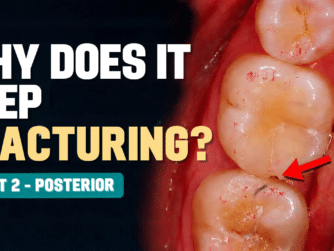
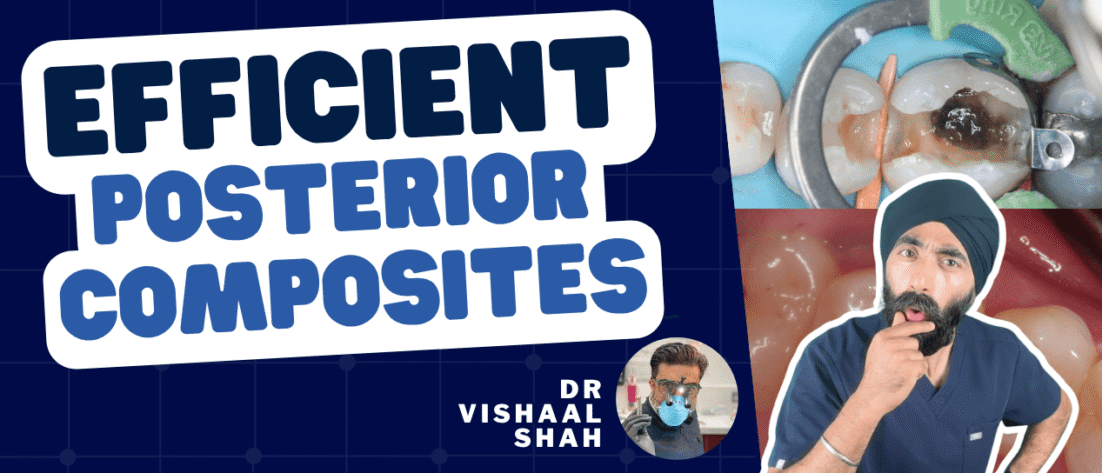
Are we overcomplicating posterior composites?
Are those beautiful fissures and stains actually helping the patient… or just us?
Why does that “perfect” restoration suddenly need 20 minutes of occlusal adjustment after rubber dam removal?
And how can we make functional, predictable composites without burning time or stress?
In this episode, Dr. Vishaal Shah shares a refreshingly practical approach to posterior composites. From understanding the basics, to simplifying anatomy and improving efficiency, this is a grounded, clinically focused conversation on how to deliver restorations that actually serve the patient.
Protrusive Dental Pearl
Match your composite anatomy to the patient’s dental age and opposing dentition before you start building.
⚠️ Overbuilding cusps in a worn dentition will create occlusal interferences and wasted adjustment time
✅ Assess space, wear, and occlusion first—then design the restoration accordingly
Key Takeaways
- Function, efficiency, and occlusal compatibility should guide every restoration
- Dental age (wear) is more important than chronological age when planning anatomy
- Always assess the opposing tooth before designing cusps and fissures
- Use the whole arch—not just the contralateral tooth—as your anatomical guide
- Follow the central fissure line across the quadrant to orient your restoration
- Avoid textbook anatomy in worn dentitions—adapt to what’s present
- Large MOD composites often act as interim restorations before crowns
- Build proximal walls first to establish contact and control final contour
- Use composite slump (with a microbrush) to naturally form proximal curvature
- Base layer height should match the deepest fissure level of adjacent teeth
- Map out fissures and cusps before building to improve accuracy and speed
- Start with the most difficult cusp first to reduce fatigue-related errors
- Proper planning before drilling reduces occlusal errors and remakes
Highlights of the Episode:
- 00:00 Teaser
- 01:08 Introduction
- 01:50 Pearl: Matching Anatomy to Dental Age
- 05:32 Posterior Composite: Start with Basics, Not Complexity
- 10:42 Efficient Approach to Large Restorations
- 14:22 Efficiency vs Ideal Posterior Restorations
- 19:25 Building Proximal Walls First
- 20:55 Using Putty Stents for Missing Cusps
- 23:54 Midroll
- 27:15 Using Putty Stents for Missing Cusps
- 27:25 Matrix System Selection
- 28:06 No Pre-Wedging Philosophy
- 29:06 Managing Composite Overhangs
- 30:46 Matrix Ring Differences
- 32:45 Interjection
- 37:03 Matrix Ring Differences
- 37:43 Proximal Wall Technique for Posterior Composite
- 41:03 Base Layer Strategy in Posterior Restorations
- 42:23 Mapping Anatomy Before Composite Build-Up
- 43:13 Cusp Build-Up Approach
- 45:03 Minimal Adjustment Philosophy
- 46:43 Final Philosophy: Keep It Simple
- 48:00 Learning Opportunities
- 49:54 Outro
🔥 Want to level up your posterior composites?
Dr. Vishaal Shah runs hands-on courses focused on simplifying and mastering everyday restorations.
👉 Visit www.levelupdentistry.com to explore courses and upcoming training opportunities.
More about posterior restorations:
Check out more episodes on occlusion and restorative dentistry: How to Place Posterior Composites without Destroying Your Anatomy – PDP200
#PDPMainEpisodes #BreadandButterDentistry
This episode is eligible for 0.75 CE credit via the quiz on Protrusive Guidance.
This episode meets GDC Outcomes C
AGD Subject Code: 250 Operative Dentistry
Aim: To enhance clinicians’ understanding of efficient, functional posterior composite techniques with a focus on anatomy, occlusion, and practical workflow.
Dentists will be able to –
- Assess dental age and occlusal compatibility when planning posterior composites
- Apply simplified, efficient techniques to build functional posterior restorations
- Select appropriate materials and matrix systems to optimise contact, contour, and outcomes
Continuing Education Information
This activity may be eligible for continuing education credit through Protrusive Guidance. Participants must complete the associated quiz inside Protrusive Guidance to obtain a CPD/CE certificate.
Cost:
Access to this CE activity is included with an active Protrusive Guidance membership. Current membership pricing is available at www.protrusive.app.
Cancellation & Refund Policy:
Memberships may be cancelled at any time. Access to CE activities remains active until the end of the current billing cycle. Subscription charges are non-refundable once processed. Full details are available at www.protrusive.app.
Delivery: Self-instruction (online) · Location: Online
Contact: manager@protrusive.co.uk