Full mouth reconstruction — is the aim really the flawless before-and-after you scroll past on Instagram, or is that a trap?
How do you actually know you’re ready to step up from single teeth to a whole mouth?
And when your comprehensive treatment plan keeps getting declined — psychologically, financially — is that the patient’s problem, or yours?
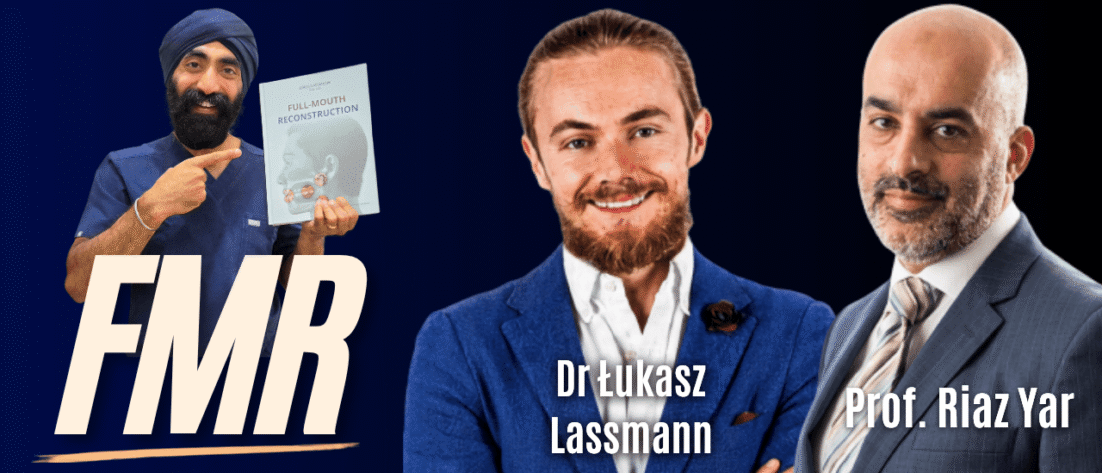
This one is a “your questions answered” episode: the community sent in far more FMR questions than we could cover, and we put the best of them to two prosthodontists who literally wrote the book on it.
This is a full-mouth reconstruction deep dive with Prof Riaz Yar and Dr Łukasz Lassmann — co-authors of the new Quintessence textbook Full-Mouth Reconstruction (foreword by Jeffrey Okeson). We cover screening before you commit, knowing when you’re ready, getting big plans accepted, choosing materials, setting the bite in centric relation, sleep apnea, and the honest truth about “perfect” versus “acceptable.”
Protrusive Dental Pearl: Always Present the Best Advice
When you present a complex case, offer three tiers. Best advice — take time and money out of the equation and describe the ideal: what would truly get this patient to the right result (gum grafting, orthodontics, the lot). A compromise — a good result without the parts the patient won’t consent to or can’t fund. And the minimum — the least that still helps, with the non-negotiables named.
The most important of the three is the best advice. It’s tempting to self-censor — to decide a plan is too elaborate or too expensive and quietly leave it out. But if you never present the best option, you’ll never get to do those cases. Present the ideal option first, then offer the compromises. Don’t limit the patient — or yourself.
What You’ll Take From This Episode
- Screen before you plan — a green / orange / red system that sorts patients before treatment planning even starts, so you know which cases are yours.
- How to get big plans accepted — why case acceptance is a confidence problem before it’s a skills problem, and how to present the best advice, compromise and minimum.
- Choosing materials — why it’s the case, not the material: repairability vs aesthetics vs durability, and why erosion changes the answer.
- Setting the bite — why centric relation is the reference position, what a night guard can do to it, and how sleep apnea changes the plan.
- Perfect vs acceptable — defining success and failure honestly, and knowing when you’re actually ready to take a full-mouth on.
Highlights of This Episode
00:00 TEASER
00:53 Full Mouth Reconstruction: Your FMR Questions Answered
05:08 What Actually Counts as a Full Mouth Reconstruction?
10:48 Screening Patients for Full Mouth Rehab: Green, Orange, Red
18:48 Is Perfect the Goal of Every FMR? Success vs Failure
26:53 How Do You Know You’re Ready for Full Mouth Dentistry?
36:23 Is the Dahl Concept a Good Segue Into Full Mouth Rehab?
38:50 Midroll
42:49 How to Get Patients to Accept Full Mouth Treatment Plans
49:34 Best Advice, Compromise, Minimum: Presenting the Options
55:04 Give Yourself Permission to Fail in Big Cases
56:14 FMR or Selective Restorations? Where’s the Line on Tooth Wear?
58:49 Interjection 1 – BEWE and BEWE 2.0
1:04:52 Composite, Ceramic or Zirconia? Choosing FMR Materials
1:09:53 Interjection 2 – Vertipreps and BOPT?
1:12:40 Centric Relation, Sleep Apnea and Setting the Bite
1:17:25 Anteriors or Posteriors First in a Full Mouth?
1:26:00 Does DTR Change How You Finish an FMR?
1:27:35 The Full-Mouth Reconstruction Book & Where to Learn More
1:30:37 OUTRO
From the Guests
Prof Riaz Yar is a specialist prosthodontist and Visiting Professor in Prosthodontics, with a 25-year focus on TMD, occlusion and full-mouth dentistry. Dr Łukasz Lassmann is a prosthodontist (DDS, PhD) whose PhD is in occlusion and the temporomandibular joint; he focuses on tooth wear, TMD and full-mouth rehab and founded Lassmann Education, whose multi-day “summer camp” FMR/occlusion course runs in Poland.
Interested in Full Mouth Reconstruction? Check out their book:
Full-Mouth Reconstruction (Lassmann & Yar, Quintessence Publishing, 2026; foreword by Jeffrey Okeson) — a general-practitioner workflow from screening through orthodontics, perio, preparation, and cementation.
References & Further Reading
Sources and further reading from this episode:
- Lassmann Ł, Yar R. Full-Mouth Reconstruction. Quintessence Publishing, 2026 (foreword by Jeffrey P. Okeson). ISBN 978-1-78698-153-0.
- Lassmann Ł, Calamita MA, Blatz MB. The “Smile Design and Space” (SDS) concept for altering vertical dimension of occlusion and esthetic restorative material selection. J Esthet Restor Dent. 2025;37(1):56–67.
- Loomans B, Opdam N, Attin T, et al. Severe tooth wear: European consensus statement on management guidelines. J Adhes Dent. 2017;19(2):111–119.
- Bartlett D, Ganss C, Lussi A. Basic Erosive Wear Examination (BEWE): a new scoring system for scientific and clinical needs. Clin Oral Investig. 2008;12(Suppl 1):S65–S68.
- Okeson JP. Management of Temporomandibular Disorders and Occlusion. Elsevier (8th edition)
Want more?
If you enjoyed this episode, check out: [Occlusion Myths and Red Flags with Lukasz Lassmann – PDP225]
Tags
#PDPMainEpisodes #OcclusionTMDandSplints #OrthoRestorative
Listen, Subscribe, Earn CPD
Listen: Subscribe to the Protrusive Dental Podcast on Spotify, Apple Podcasts, or YouTube.
This episode is eligible for 1.5 CE credit via the quiz on Protrusive Guidance.
This episode meets GDC Outcomes C.
AGD Subject Code: 610 Fixed Prosthodontics.
Aim & Learning Outcomes
Aim: To give dental practitioners a practical, decision-led approach to full mouth reconstruction — how to screen and select patients, communicate and gain acceptance for comprehensive plans, choose restorative materials, and establish a stable, repeatable occlusion.
Learning Outcomes — by the end of this episode, dentists will be able to:
- Apply a structured screening approach to categorise a patient’s suitability and complexity before committing to full mouth treatment, and identify a realistic point of readiness for taking such cases on.
- Communicate comprehensive treatment plans as tiered options (ideal/best, compromise, minimum) with informed consent, and articulate why the clinician’s conviction and clear documentation affect both acceptance and liability.
- Differentiate the factors governing restorative material selection and occlusal reference position in full mouth cases, including the rationale for centric relation and the influence of tooth wear cause, substrate and sleep-disordered breathing.
Continuing Education Information
This activity may be eligible for continuing education credit through Protrusive Guidance. Participants must complete the associated quiz inside Protrusive Guidance to obtain a CPD/CE certificate.
Cost:
Access to this CE activity is included with an active Protrusive Guidance membership. Current membership pricing is available at www.protrusive.app.
Cancellation & Refund Policy:
Memberships may be cancelled at any time. Access to CE activities remains active until the end of the current billing cycle. Subscription charges are non-refundable once processed. Full details are available at www.protrusive.app.
Delivery: Self-instruction (online) · Location: Online
Contact: manager@protrusive.co.uk