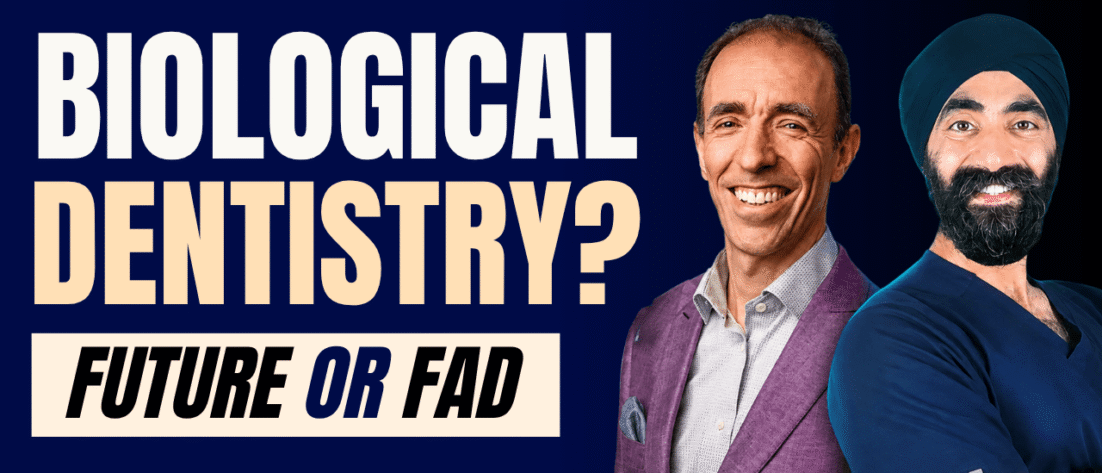
Holistic, biological, functional — is there actually a difference, or is it all just marketing?
Are root canals really dangerous — or is that just what the algorithm keeps showing your patients?
When a patient wants their sound fillings out, do you test, reassure, or drill?
And how do you bring sleep, diet and blood tests into a dental appointment without it stopping being dentistry?
This episode sits down with Dr James Goolnik — clinical dentist, founder of the London holistic practice Optimal Dental Health, past President of the British Academy of Cosmetic Dentistry, and one of Jaz’s earliest mentors. James openly calls himself a holistic and biological dentist, which makes him the ideal person to separate the thoughtful, evidence-aware end of this world from the online extremism that gives it a bad name. Expect a balanced, honest conversation: some of it you’ll adopt tomorrow, some of it you’ll want to pressure-test — which is exactly the point.
Protrusive Dental Pearl: Dentistry Isn’t Just About Fixing Teeth
This one isn’t a clinical tip — it’s a sentiment that frames the whole episode. Dentistry isn’t just about fixing teeth; it’s about improving health. You don’t have to agree with every claim made in biological dentistry — but you will struggle to disagree that a patient’s diet, sleep, breathing, stress and inflammation all influence oral health.
So the pearl is simple: stay curious, stay open-minded — but stay critical, and never stop asking better questions.
What You’ll Take From This Episode
- The holistic–biological spectrum — what each word actually means, and where thoughtful practice tips into online extremism.
- Test or reassure? — the three-question filter for deciding whether any test earns its place before you order it.
- Safe amalgam removal — the SMART protocol, and when a worried patient’s sound filling should be left well alone.
- The mouth-body connection — how sleep, glucose control and systemic inflammation affect the mouth, and where to refer.
- The balanced take on root canals and implants — whether root canals are dangerous, and titanium versus ceramic with metal-allergy testing.
Highlights of This Episode:
00:00 Teaser
00:59 Holistic vs Biological Dentistry: What’s the Difference?
05:49 Why Listening Beats Perfect Margins in Dentistry
10:29 Why Patients Started to Doubt Root Canal Treatment
12:09 Mercury Fillings: Should You Remove Amalgam?
14:09 The SMART Protocol for Safe Amalgam Removal
19:59 The Mouth-Body Connection: Sleep, Diabetes & Alzheimer’s
24:59 How to Build Nutrition Into a Dental Practice
26:25 Midroll
34:01 Sleep Tests, Glucose Monitors and Blood Tests in Practice
38:21 Is Biological Dentistry Dangerous? The Extremist Problem
39:21 Are Root Canals Dangerous? A Balanced Take
41:51 Titanium vs Zirconia Implants and Metal Allergy Testing
46:51 When Removing a Healthy Tooth Becomes Negligent
50:56 What Diet Should Dentists Actually Follow?
53:41 How to Get Started in Holistic Dentistry
56:30 Outro
From the Guest
Dr James Goolnik is a clinical dentist and founder of Optimal Dental Health, a holistic practice in London built around integrating nutrition, sleep and whole-health screening into everyday dentistry. He is a past President of the British Academy of Cosmetic Dentistry, a member of the International Academy of Oral Medicine and Toxicology, and the author of “Brush” (profits to Dentaid) and the “Kick Sugar” cookbook (profits to his Rewards Project charity).
👉 Optimal Dental Health — monthly practitioner newsletter, and connect with James on LinkedIn
Want the Toolkit?
We’ve turned this episode into a practical Holistic Dentistry Clinical Toolkit — with quick-reference guides for whole-body assessment, testing, patient conversations, and navigating the holistic–biological spectrum.
Download the free toolkit at www.protrusive.co.uk/biological
References & Further Reading
Sources and further reading from this episode:
- IAOMT — Safe Mercury Amalgam Removal Technique (SMART). The protocol for safely removing amalgam (rubber-dam isolation, adsorbent rinse, sectioning, high-volume evacuation) to minimise mercury exposure for patient and team.
- MELISA test. A validated blood lymphocyte-transformation test for type-IV hypersensitivity to metals including titanium and mercury — used to guide titanium-vs-ceramic implant decisions.
- Tests, devices & materials referenced — a home overnight sleep test, a phase-contrast microscope, a national blood-testing partner, point-of-care fingerprick analysers (CRP / HbA1c), a blood/hair/urine mercury panel, continuous glucose monitors, and Biodentine for vital-pulp therapy.
Want more?
If you enjoyed this episode, check out: Implementing Sleep, Airway and Myo to Restorative Dentistry Part 1 — PDP262
Tags
#PDPMainEpisodes #Communication #BeyondDentistry
Listen, Subscribe, Earn CPD
Listen: Subscribe to the Protrusive Dental Podcast on Spotify, Apple Podcasts, or YouTube.
This episode is eligible for 1.0 CE credit via the quiz on Protrusive Guidance.
This episode meets GDC Outcomes C.
AGD Subject Code: 150 Health, medicine and nutrition.
Aim & Learning Outcomes
Aim: To give dentists a balanced, evidence-aware understanding of holistic and biological dentistry — what the terms mean, how to integrate whole-health thinking and appropriate testing into practice, and how to navigate patient beliefs about root canals, mercury and metal-free dentistry without abandoning the evidence base.
Learning Outcomes — by the end of this episode, dentists will be able to:
- Differentiate between holistic and biological approaches to dentistry, and articulate where evidence-based, minimally invasive care ends and unsupported claims begin.
- Apply a structured decision filter to judge whether an additional test or intervention is justified — whether it will change treatment, provide a benchmark, or motivate the patient — while working within scope and referring appropriately.
- Describe the mouth-body connections — sleep-disordered breathing, glycaemic control and systemic inflammation — that support integrating general-health screening and communication into routine dental care.
Continuing Education Information
This activity may be eligible for continuing education credit through Protrusive Guidance. Participants must complete the associated quiz inside Protrusive Guidance to obtain a CPD/CE certificate.
Cost:
Access to this CE activity is included with an active Protrusive Guidance membership. Current membership pricing is available at www.protrusive.app.
Cancellation & Refund Policy:
Memberships may be cancelled at any time. Access to CE activities remains active until the end of the current billing cycle. Subscription charges are non-refundable once processed. Full details are available at www.protrusive.app.
Delivery: Self-instruction (online) · Location: Online
Contact: manager@protrusive.co.uk