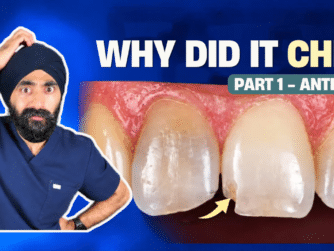
Last week, we looked at why anterior composites chip. This week, we’re moving to the back of the mouth.
You replace a large restoration, build the contact, sculpt the anatomy and polish it beautifully. Lovely job.
Then, the patient returns with a piece missing. 😬
Was the composite too weak? Was the bite high? Or were we asking more of that restoration than it could deliver?
Posterior composites can chip/fracture when loading exceeds what the material, its bond and the remaining tooth can tolerate. Before changing the composite, work out which part of that combination needs attention.
The useful question is: what needs to be different this time?
First, Work Out What Actually Broke.
“The filling broke” can mean several things.
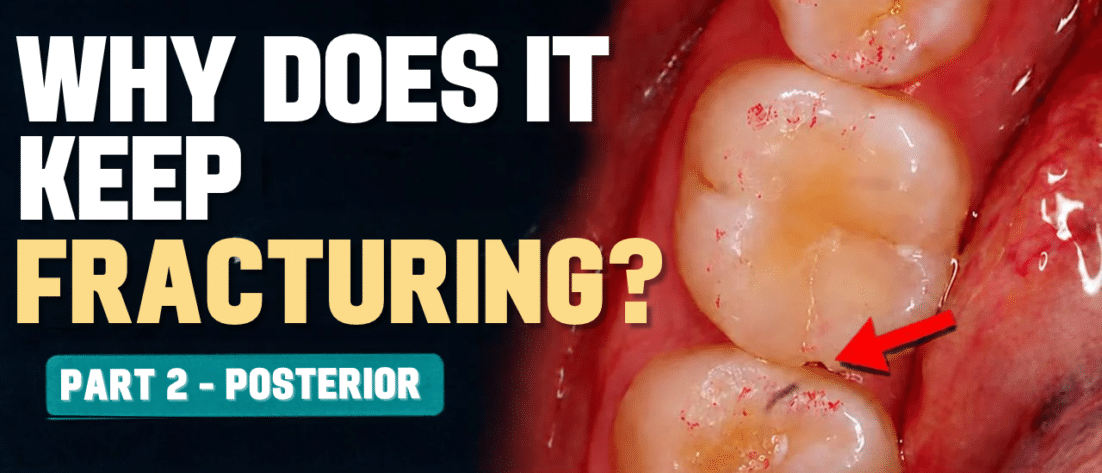
A fragment missing from a marginal ridge (very common), a restoration that has detached/debonded entirely (thankfully rare but only happened to me 1 year ago and I was devastated!), and a fractured natural cusp deserve different investigations. Sometimes more than one structure is involved.
Ask when it happened, whether there was pain before the fracture and whether the same area has failed before. Examine the remaining restoration and tooth, including any suspected cracks.
It is tempting to focus on the missing piece. But rebuilding it is only useful once you understand what you are repairing and what you may do differently.
If the restoration fractured recently, I always wonder ‘why did this tooth need restoring in the first place’?
After asking myself this over the years, I found that IF the reason for restoring the tooth in the first place was a cracked tooth, then the restoration is significantly more likely to fracture/get overloaded than a tooth you restored for caries.
The key lesson is here that the past predicts the future – cracks happen (in part) due to high force and overload. Just because you place a restoration there will not necessarily prevent the overload. We must pay careful attention to restoration design and occlusion in these scenarios.

Beautiful Anatomy, but Does It Belong in This Mouth?
A heavily worn dentition does not necessarily need a brand-new molar with steep cusps and deep fissures. However lovely it looks in the photograph!
In PDP266 — Posterior Composites Done Right in my chat with Dr Vishaal Shah, I emphasised matching anatomy to the patient’s dental age, opposing teeth and existing wear.
Think about that when investigating a fractured restoration. Did the restoration introduce a contour or contact that was not there before?
Did you build an impressive cusp, then spend ten minutes adjusting it away once the rubber dam came off?
The opposing dentition and the rest of the arch help you understand the space and anatomy available. Look beyond the tooth you are restoring.
CLINICAL PEARL: Build anatomy that works in THIS mouth. Flat teeth will unfortunately mean flat restoration unless you open the vertical dimension and carry out full mouth rehab.
MIP vs Dynamic
One of the useful lessons from Unchippable with Jaz and Mahmoud is to consider whether a restoration obstructs chewing or parafunctional movements. The ‘envelope of function’ and ‘envelope of parafunction’.
The webinar illustrates this largely with anterior cases. The question is still worth asking posteriorly: how is this restoration being loaded when the jaw moves?
A comfortable MIP ‘tap, tap, tap’ does not answer every functional question. Review relevant excursions. If the patient says the tooth catches or feels uncomfortable during a particular movement, ask them to demonstrate it. Is a guiding cusp/incline too steep and not in harmony with the rest of the teeth? Did you intend for this restoration to provide guidance or not?
Dr Lane Ochi’s PDP175 — Cracked Teeth and Dentistry’s Tough Questions explores force management, mechanical failures and posterior wear.
Understand the contact pattern before deciding what needs adjustment. The chip gives you a reason to investigate; it does not establish an occlusal diagnosis on its own.
Is There Enough Support for What You Have Built? This Is a Big One!
A small occlusal restoration and a large MOD with weakened cusps are very different propositions. Assess the remaining walls, cracks and opposing contacts. Should the cusps have been capped?
Then look at the marginal ridge. A tight contact alone does not mean you’ve built a strong one!

A straight, non-contoured matrix can create a flat proximal surface with the contact too close to the marginal ridge, leaving a thin ridge vulnerable to chipping.
A well-adapted, pre-contoured sectional matrix helps create a natural contour, with the contact below the ridge and a rounded transition into the occlusal embrasure. This allows more composite bulk where it matters.
The goal isn’t a lower contact. It’s a properly shaped marginal ridge with enough bulk to cope with the load.

Could a Crack Be Part of the Problem?
Do not let a small missing piece distract you from the rest of the tooth.
Pain on biting or release, persistent symptoms or repeated failures deserve a fuller assessment before another repair. These findings do not prove a crack, but they should make you pause.
In PDP246 — Cracked Teeth Clinical Guidelines, Dr Masoud Hassanzadeh discusses diagnosis, monitoring and intervention, including caution around chasing cracks.
Ask yourself: am I repairing a local composite defect, or managing a compromised tooth?
Those may need different plans. Replacing the visible corner does not necessarily address what is happening underneath it.
Does This Tooth Need A Cuspal Coverage?
Not automatically because the restoration is large!
But if a cusp is compromised, repeatedly rebuilding the missing corner may leave the underlying problem unresolved.
In Onlays Shmonlays, I explain how to decide which cusps need covering. Measure the remaining cusp at its narrowest point after removing caries and old restorations. Around 2 mm is a useful guide for considering coverage, but it isn’t a magic number. Cavity depth, cracks, loss of marginal ridges and loading all influence the decision.

Think short and fat versus thin and long. Two cusps can have the same thickness, but the one beside a deeper cavity is more prone to flexure.

Where the opposing tooth contacts also matters: is the force squeezing the cusp inwards or pushing it outwards?

Cuspal coverage does not automatically mean an indirect restoration. Direct composite can cover cusps too. First decide what needs protecting, then choose how to restore it.
If you’re unsure when to preserve a cusp and when to cover it, Lesson 1 of Onlays Shmonlays Online Course walks you through that decision, with the functional assessment developed further in Lesson 2.
Do Not Blame Grinding for Every Chip.
Unchippable also reminds us to consider patient habits alongside our own restorative decisions.
Ask about chewing ice or hard objects without making the patient feel accused. Review previous fractures and wear patterns. If parafunction is a concern, include it in planning and follow-up.
An appliance may be appropriate, but it should not be the only thing standing between the restoration and another fracture.

Before Repairing It, Do A Dental ‘Pre-Mortem.’
The dental pre-mortem asks you to anticipate failure before it happens. Apply that thinking to the repair:
- What fractured: composite, tooth or the bonded interface?
- Does the proposed shape suit the opposing dentition?
- Is the remaining tooth adequately supported?
- Are cracks or symptoms changing the plan?
- What will be different after this repair?
That last question deserves a moment, Protruserati. If the same corner keeps breaking and the plan is exactly the same, pause before reaching for the syringe.
A chipped posterior composite is a reason to reassess the whole tooth. Give the next restoration a better reason to last.
For a deeper discussion of restoration design and force management, revisit Unchippable with Dr Jaz Gulati and Dr Mahmoud Ibrahim.
Kate and Jaz
Continuing Education Information
This activity may be eligible for continuing education credit through Protrusive Guidance. Participants must complete the associated quiz inside Protrusive Guidance to obtain a CPD/CE certificate.
Cost:
Access to this CE activity is included with an active Protrusive Guidance membership. Current membership pricing is available at www.protrusive.app.
Cancellation & Refund Policy:
Memberships may be cancelled at any time. Access to CE activities remains active until the end of the current billing cycle. Subscription charges are non-refundable once processed. Full details are available at www.protrusive.app.
Delivery: Self-instruction (online) · Location: Online
Contact: manager@protrusive.co.uk