What if your mentor could watch your surgery live — from another continent?
Is your loupe camera footage actually usable, or is half of it the patient’s cheek?
What happens when a patient can see their own check-up through smart glasses?
And how do you learn surgery you’ve never done, in a country with fewer than ten dentists?
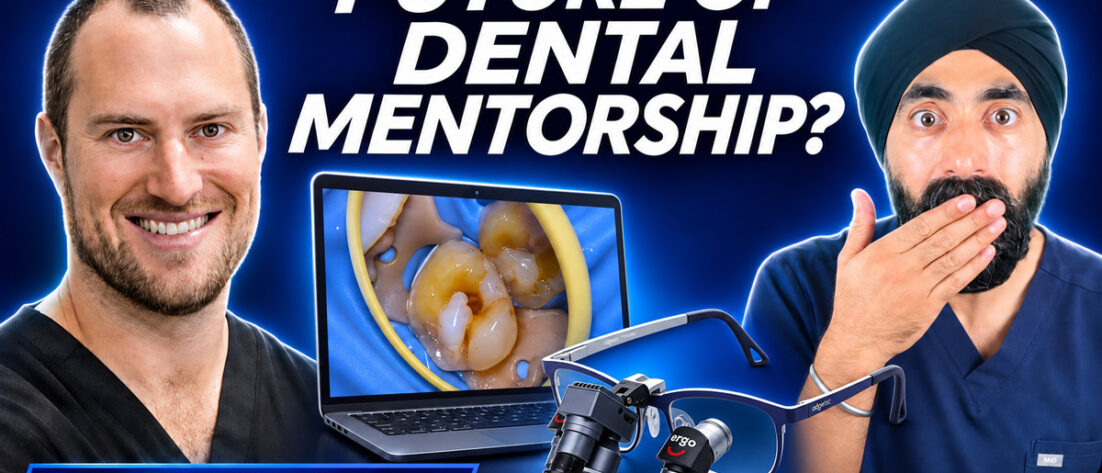
Most of us who buy a loupe-mounted camera buy it to film our own work. In this episode I catch up with Dr James Hunter, who moved his family from Cornwall to Monrovia, Liberia, to help run a dental clinic and teach at the country’s dental therapy school. A year in, his loupe camera has become something much bigger: a way to be coached live by a senior surgeon in another country, and a way to show students exactly where to put their forceps.
We cover the six jobs a loupe camera can do, the set-up mistakes that ruin footage, how I use the guided tour oral exam with patients, and why I think virtual shadowing is the future of dental mentorship. Some of James’s cases are confronting — this is dentistry at a scale most of us never see.
What You’ll Take From This Episode
- Six jobs for a loupe camera — from self-reflection to live mentorship, teaching, patient education and building a video library.
- Virtual shadowing — how a mentor can coach you through a procedure in real time, and why it suits busy mentors too.
- Which feedback mode fits the moment — live stream, recorded clips or annotated stills, depending on the question and your bandwidth.
- Footage you can actually use — the set-up and filming habits that separate usable video from a blurry cheek.
- The guided tour oral exam — streaming your loupe view to the patient’s smart glasses as you examine.
Highlights of This Episode
00:00 TEASER
00:48 Dental Videography: Beyond Recording Your Own Cases
02:41 Virtual Shadowing: The Future of Dental Mentorship
04:06 Life as a Dentist in Liberia: One Year On
11:24 Severe Dental Infections and Osteomyelitis in Children
14:32 Using a Loupe Camera to Get Remote Mentorship
17:10 Live-Streaming Surgery to a Mentor Over Zoom
19:21 The Guided Tour Oral Exam: Patient Education with Smart Glasses
20:17 MIDROLL
23:11 How to Edit Dental Video: Snapshots, Clips and AI Editing
26:12 Loupe Camera Set-Up Mistakes: Focus, Alignment and White Balance
26:55 Intentional Replantation on Incisors: A Real-World Case
29:25 How to Frame Dental Video for the Camera
31:14 Training Dental Therapists in Liberia with a Loupe Camera
33:53 Why Dental Schools Should Use Loupe-Mounted Cameras
38:00 SURGhub and Building a Free Dental Video Library
39:17 How to Support Dental Care in Liberia
39:24 OUTRO
From the Guest
Dr James Hunter graduated from Cardiff University and practised in Perranporth, Cornwall, before moving to Monrovia with his family in August 2025. He helps run the dental clinic on the ELWA Hospital compound and teaches at the Liberia Dental Therapy School, which trains dental therapists to provide safe extractions in counties with no oral healthcare. He is building a library of clinical teaching videos for low-resource settings.
👉 The Hunters in Liberia — updates and ways to support
👉 Liberia Dental Therapy School
On Instagram: search “The Hunters in Liberia”. James is also a member of the Protrusive Guidance community — you can message him there.
References & Further Reading
- The guided tour oral exam. How I stream my loupe camera to a patient’s smart glasses: protrusive.co.uk/gtoe
Want more?
If you enjoyed this episode, check out: Dental Aid Work – Ditching the Rat Race for a Charitable Cause – IC050
Tags
#BeyondDentistry #CareerDevelopment #Communication
Listen, Subscribe, Earn CPD
Listen: Subscribe to the Protrusive Dental Podcast on Spotify, Apple Podcasts, or YouTube.
This episode is eligible for 0.5 CE credit via the quiz on Protrusive Guidance.
This episode meets GDC Outcomes C.
AGD Subject Code: 149 Multi-disciplinary topics
Aim & Learning Outcomes
Aim: To show dental professionals how loupe-mounted video can be used beyond recording their own procedures — for remote mentorship, teaching and patient education — and how to capture footage that is fit for those purposes.
Learning Outcomes — by the end of this episode, dentists will be able to:
- Describe the clinical uses of loupe-mounted video, including self-reflection, asynchronous and live remote mentorship, chairside teaching and patient education.
- Apply set-up and filming principles — focus calibration to working distance, alignment, white balance, retraction and shot composition — to capture usable clinical footage.
- Select an appropriate mode of video-based feedback (live streaming, recorded clips or annotated stills) for a given clinical question and resource constraint, and inform patients when observers are watching.
Continuing Education Information
This activity may be eligible for continuing education credit through Protrusive Guidance. Participants must complete the associated quiz inside Protrusive Guidance to obtain a CPD/CE certificate.
Cost:
Access to this CE activity is included with an active Protrusive Guidance membership. Current membership pricing is available at www.protrusive.app.
Cancellation & Refund Policy:
Memberships may be cancelled at any time. Access to CE activities remains active until the end of the current billing cycle. Subscription charges are non-refundable once processed. Full details are available at www.protrusive.app.
Delivery: Self-instruction (online) · Location: Online
Contact: manager@protrusive.co.uk