
Which appointment in your diary makes your stomach drop when you see it?
Is the word emergency quietly making your urgent visits harder than they need to be?
How do you settle a stranger who is anxious, in pain and hasn’t slept — when you have fifteen minutes?
And how do you stop a run of one-off patch-ups turning into a career you never chose?
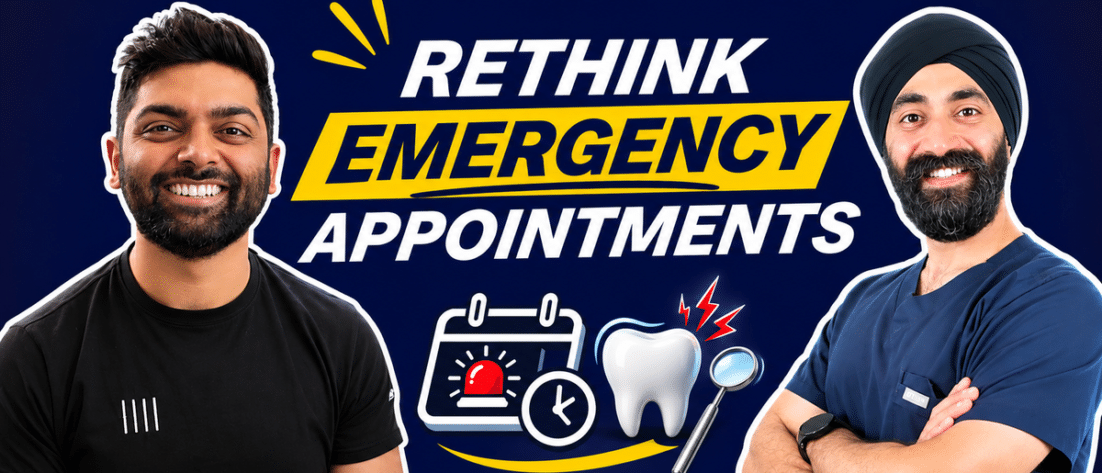
Dr Zak Kara — one of the principal dentists at Smile Stories in Bournemouth — is back on the podcast. Smile Stories doesn’t book “emergencies”; it books “get you out of trouble” visits, and once you hear why, you start to notice how much the words on your website, on the phone and in the chair shape what patients expect before they arrive. This is a warm, practical conversation about urgent care as a communication problem: setting the frame before the visit, calming anxious patients in the room, and turning a patch-up into the start of a long-term relationship — or recognising when a patient isn’t the right fit.
Protrusive Dental Pearl: Set the Expectation Before You Start
Sometimes a patient booked as urgent sits down and it isn’t clear whether this is a rescue or a consultation — and the two run differently. So slow down for the first few seconds, even when the slot is tight. A calm tone at the start makes you the calm, in-control dentist — perception becomes reality. Then say what the visit is for: you’ll make them comfortable, find out what’s been bothering them, and talk through the best way to get them out of trouble today.
When the picture is grey, ask: are they expecting rescuing, or a thorough check with an explanation and a plan? And don’t promise definitive treatment you can’t deliver in time — a broken cusp that needs a multi-surface restoration won’t be done properly in 20 minutes. Agreeing the scope up front is what stops the visit ending in disappointment.
What You’ll Take From This Episode
- Name the visit, set the ceiling — why “emergency” creates an obligation you can’t always meet, and what to call it instead.
- Urgent, necessary, beneficial — the urgency-graded plan that means the next step is already written when something breaks.
- The ladder of readiness — the one question to ask at the end of every urgent visit, and how to read the answer.
- Green, amber and red patients — why too many reds quietly reshape your diary, your team and your career.
- Calming the anxious stranger — why you shouldn’t rush, why “I know your story already” matters, and the gentle words that show you have their best interests at heart.
Highlights of This Episode
00:00 TEASER
00:56 Why Emergency Dental Appointments Are So Stressful
04:16 Protrusive Dental Pearl: Set Expectations at the Start of an Urgent Visit
08:56 Why What You Call an Emergency Appointment Matters
10:56 New vs Returning Patients: Why Urgent Visits Differ
14:46 Managing Patient Expectations: Where Happy Patients Come From
18:46 How Practice Culture Shapes What Patients Expect
20:26 The “Get You Out of Trouble” Visit: Why We Stopped Saying Emergency
25:06 Should You Block Out Emergency Slots in Your Diary?
26:26 Urgent, Necessary, Beneficial: Treatment Plans That Prevent Emergencies
29:46 Handling a Broken Tooth With a Photo and the Existing Plan
35:46 Choosing Your Patients: The Busy Restaurant Philosophy
41:56 The Question to Ask at the End of Every Urgent Visit
44:26 Do You Have to Treat Everyone? Green, Amber and Red Patients
52:46 How to Calm an Anxious Patient at an Urgent Appointment
58:36 How to Talk Patients Through Topical, Local and Oral Cancer Checks
1:03:50 OUTRO
From the Guest
Dr Zak Kara is one of the principal dentists at Smile Stories in Bournemouth, where the line on the door reads “Nothing like your old dentist.” His course, The Chairside Cookbook, brings together the everyday conversations of dentistry — appointment structure, flow, and the actual words he uses, including the hardest moments, such as “I’ll have a think about it.”
👉 The Chairside Cookbook — Zak’s communication course
Disclosure: Protrusive certifies the course’s CPD, hosts its podcast edition, and runs its 90-day accountability group inside Protrusive Guidance.
Want more?
If you enjoyed this episode, check out: Think Comprehensive – Communication Gems with Zak Kara – PDP010
Tags
#PDPMainEpisodes #Communication #CareerDevelopment
Listen, Subscribe, Earn CPD
Listen: Subscribe to the Protrusive Dental Podcast on Spotify, Apple Podcasts, or YouTube.
This episode is eligible for 1 CE credit via the quiz on Protrusive Guidance.
This episode meets GDC Outcomes A and B.
AGD Subject Code: 550 Practice Management and Human Relations.
Aim & Learning Outcomes
Aim: To help dental professionals run urgent appointments that relieve the immediate problem, manage expectations and patient anxiety, and lay the foundations for a long-term, preventive relationship.
Learning Outcomes — by the end of this episode, dentists will be able to:
- Describe how the language used to name and book urgent appointments — online, by phone, in practice software and chairside — shapes patient expectations and the scope of the visit.
- Apply a structured approach to urgent visits for new and returning patients: setting expectations at the outset, reducing anxiety, delivering the necessary care and inviting a preventive conversation at the end.
- Use an urgency-graded treatment plan (urgent, necessary, beneficial) to prioritise care and reduce future unplanned urgent visits.
Continuing Education Information
This activity may be eligible for continuing education credit through Protrusive Guidance. Participants must complete the associated quiz inside Protrusive Guidance to obtain a CPD/CE certificate.
Cost:
Access to this CE activity is included with an active Protrusive Guidance membership. Current membership pricing is available at www.protrusive.app.
Cancellation & Refund Policy:
Memberships may be cancelled at any time. Access to CE activities remains active until the end of the current billing cycle. Subscription charges are non-refundable once processed. Full details are available at www.protrusive.app.
Delivery: Self-instruction (online) · Location: Online
Contact: manager@protrusive.co.uk