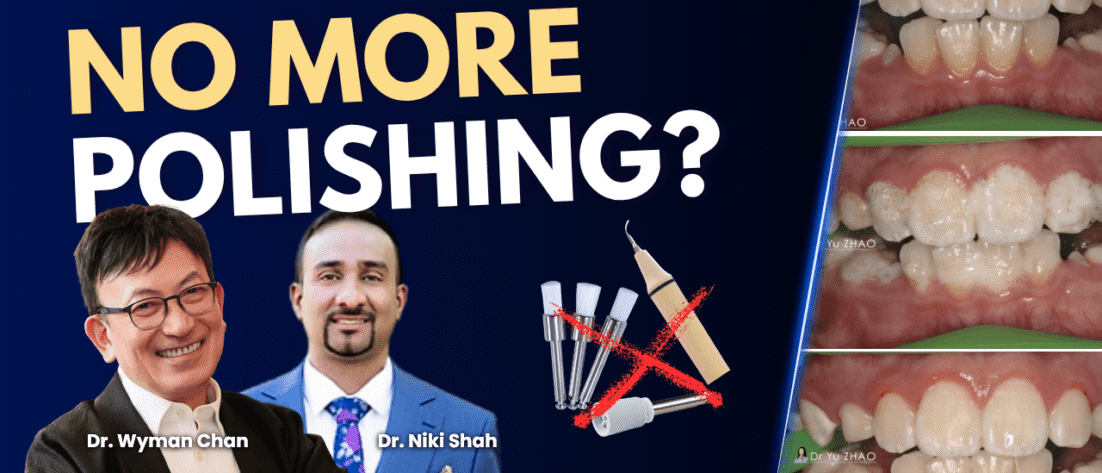
Have you ever removed plaque using a scaler or ‘air-polisher’ and notice that the demineralised enamel flaked away?
Scaling and polishing is a routine part of preventive dental care — but could some of our traditional cleaning methods be doing more than we realise? A whitening specialist who works without a drill, scaler or air polisher argues that some approaches to cleaning may affect the enamel, and that hydrogen peroxide gel can remove plaque without touching the tooth surface.
Dr Wyman Chan has done nothing but tooth whitening since 2002, when he closed his general practice for a dedicated whitening centre, and he developed the chemical-polishing gel which is at the centre of this episode. He is joined by Dr Niki Shah, a UK general dentist and practice owner whose company distributes the product in the UK, and who now runs most of his hygiene this way.
In this episode, they explain which patients they believe may benefit most, walk through the full chairside protocol, and discuss the limitations of the approach and where it may not be appropriate.
Protrusive Dental Pearl: Manicuring Worn Lower Incisors
Worn lower incisors sit sharp against the upper teeth, concentrating stress. Take a Sof-Lex disc and manicure them, rounding the edges from pointed to smooth. Show the patient in the mirror first and, borrowing Dr Michael Melkers’ framing, ask if you can make their teeth look a little younger. It is surface topography, changed for force management, and the patient feels it with their tongue.
What You’ll Take from this Episode:
- On sound enamel, prophy paste and air polishing are low-risk; on demineralised enamel hidden under plaque, the same abrasion can flake the surface.
- Chemical polishing does not lift calculus; where calculus is present, ultrasonic or hand scaling is still required.
- Dr. Wyman Chan offers a 3% hydrogen peroxide gel as a plaque and biofilm adjunct, not a replacement for oral hygiene instruction.
- The strongest cases for this are anxious, paediatric, orthodontic, special-needs and geriatric patients who tolerate scraping poorly.
- The chairside protocol runs about twelve minutes and still ends with manual agitation using a single-tufted brush.
- No published evidence supports the product’s clinical claims yet; Dr. Wyman Chan describes studies in progress.
Highlights of the Episode:
00:00 Teaser
01:21 Rethinking How We Polish Teeth
03:36 Protrusive Dental Pearl: Manicuring Worn Lower Incisors
05:23 Meet the Guests: From Whitening to Chemical Cleaning
12:10 What Is Chemical Polishing? Prophylaxis, Not Whitening
20:05 Is Traditional Polishing Damaging Teeth?
21:54 How Abrasion Harms Demineralised Enamel
25:30 The Strongest Case: Anxious Patients
29:09 Children, Adolescents and Orthodontic White Spots
29:49 Midroll
35:22 Managing Pericoronitis and Gingival Abscess
38:15 Special Needs, Geriatric and Post-Surgery Care
40:43 Where Is the Evidence? Studies in Progress
43:59 The Cost and Business Case for Chemical Polishing
50:16 The Chemical Polishing Protocol: Step by Step using Magic3
53:14 Why Manual Agitation Still Matters
57:58 How It Changed a Working Day
1:00:35 Outro
Start offering Magic3
Where to get Magic3:
- UK: directoralcare.com
- Register for a free professional account. Approval unlocks the full shop, pricing, offers and their upcoming educational courses.
- Use promo code
PROMAGIC10at checkout to receive 10% off Magic3.
- Outside UK: Please enquire from Dr Wyman Chan’s website.
- Orders are invoiced rather than purchased directly through the website.
- Quote promo code
PROMAGIC10when enquiring to receive 10% off your Magic3 order.
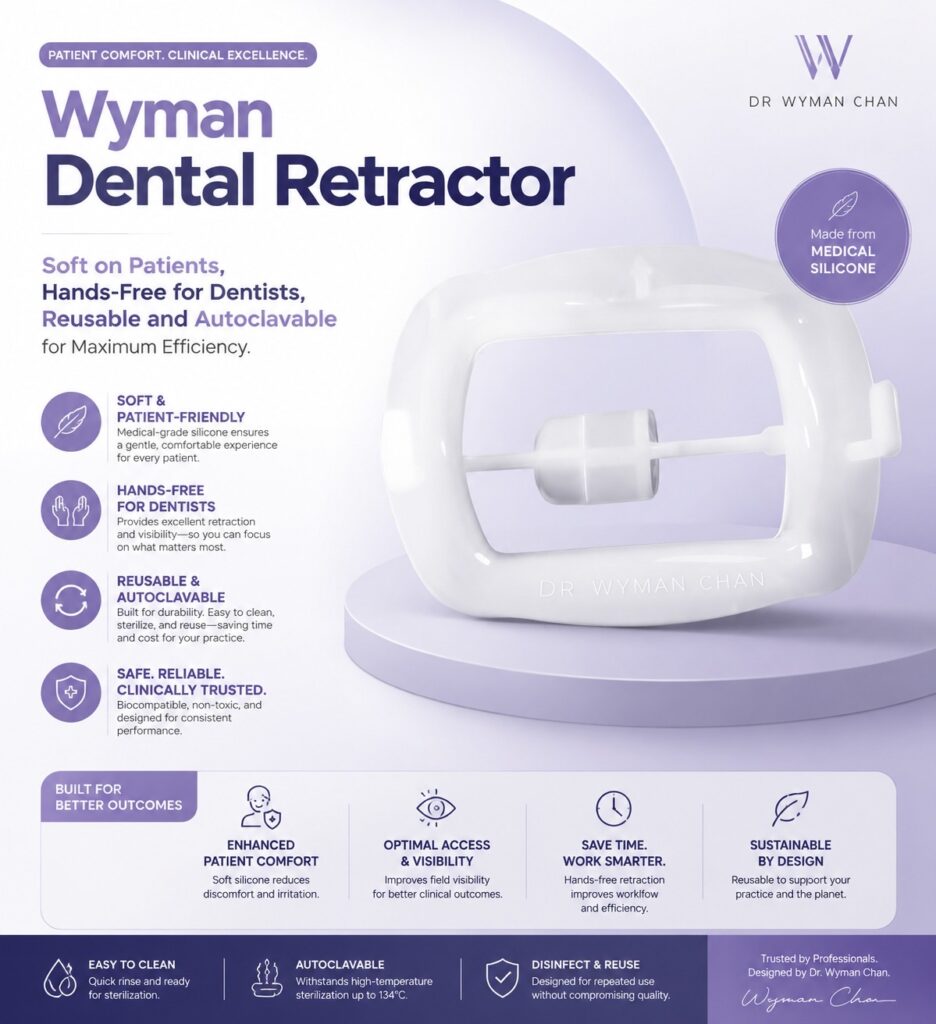
FREE Wyman Dental Retractors
With your first Magic3 order, you’ll also receive 1 Wyman Dental Retractor free.
The Wyman Dental Retractor is a multi-use, autoclavable retractor (up to 100 uses) designed for comfortable and effective soft-tissue retraction.
- Order 1–2 Magic3: Get 1 free Wyman Dental Retractor
- Order 3+ Magic3: Get 3 free Wyman Dental Retractors
Learn more about their other products HERE.
Want more?
New to Dr Chan’s work? Start with Trayless Whitening Technique Part 1 with Dr Wyman Chan – PDP277, on his whitening approach, sensitivity and how to let patients pick their target shade.
Tags
#PDPMainEpisodes
Listen, subscribe, and earn CPD
Listen: Spotify, Apple Podcasts, YouTube, and inside Protrusive Guidance.
Earn CPD: This episode is eligible for 1 CE credit via the quiz on Protrusive Guidance.
Compliance: GDC Development Outcome C. AGD Subject Code 490 Periodontics.
Aim & Learning Outcomes
Aim: To give a mechanism- and evidence-aware view of chemical polishing as an adjunct for plaque and biofilm removal: where mechanical polishing can harm demineralised enamel, which patients the approach suits, how the chairside protocol runs, and the limits of the current evidence.
By the end of this episode, dentists will be able to:
- Describe how the abrasivity of prophylaxis pastes and air-polishing powders interacts with sound versus demineralised enamel.
- Identify the patient groups for whom a non-mechanical approach to plaque removal is most appropriate, and the situations, such as calculus, where it is not.
- Evaluate the current evidence base for a 3% hydrogen peroxide chemical-polishing protocol, and apply appropriate attribution and consent where the evidence is not established.
Continuing Education Information
This activity may be eligible for continuing education credit through Protrusive Guidance. Participants must complete the associated quiz inside Protrusive Guidance to obtain a CPD/CE certificate.
Cost:
Access to this CE activity is included with an active Protrusive Guidance membership. Current membership pricing is available at www.protrusive.app.
Cancellation & Refund Policy:
Memberships may be cancelled at any time. Access to CE activities remains active until the end of the current billing cycle. Subscription charges are non-refundable once processed. Full details are available at www.protrusive.app.
Delivery: Self-instruction (online) · Location: Online
Contact: manager@protrusive.co.uk