Podcast: Play in new window | Download (Duration: 1:01:58 — 86.0MB)
Subscribe: RSS
If you showed the same bitewing to 10 dentists, would they all agree on whether to pick up the drill?
Why does the word monitoring mean nothing to a patient — and how does swapping it for active surveillance change everything from your notes to your indemnity to your government policy meetings?
Is it overtreatment to act on an E2 lesion — or is “watch and wait” actually the lazy answer dressed up as minimally invasive?
And what should you actually do with AI caries detection that flags shadows your eye doesn’t see?
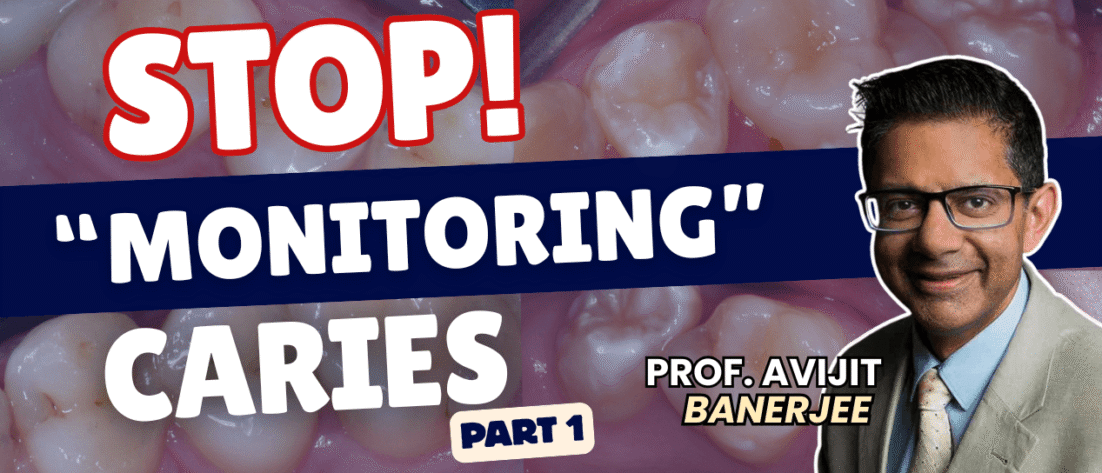
In this episode, Professor Avijit Banerjee — Professor of Cariology & Operative Dentistry at King’s College London, Honorary Consultant at Guy’s & St Thomas’, and First Dean of the Faculty of Dentistry at the College of General Dentistry — sits down with Jaz for what is genuinely one of the most important caries conversations on the podcast. Part one of two.
Avijit doesn’t do soft answers. The drill-fill-bill model is broken. “Monitoring” needs to go. “Treatment planning” is antiquated terminology medics dropped twenty-five years ago. And AI in caries diagnosis? Useful — but the moment it gets things wrong, you are the one with indemnity, not the software.
What you walk away with is a framework (MIOC), a decision filter (three factors that decide whether to pick up a bur), and a vocabulary shift you can implement tomorrow. Part two covers peptides, SDF, hydroxyapatite, stepwise excavation, and managing caries in xerostomia.
Protrusive Dental Pearl: Delete the Word “Monitor” from Your Vocabulary
Stop saying monitor. Start saying active surveillance.
⚠️ Active surveillance must not mean passive delay — document your reasoning, risk assessment, and what would trigger intervention.
✅ Explain it to patients as structured, proactive care: clinical checks, radiographs, risk review, behaviour support, and timely action if things change.
Key Takeaways
- Minimum intervention oral care is bigger than minimally invasive dentistry.
- MIOC is prevention-based, person-focused, susceptibility-related, and delivered by the whole oral healthcare team.
- MID is only one part of MIOC: operative dentistry when a tooth actually needs intervention.
- The four MIOC domains are: identify the problem, prevent lesions and control disease, provide minimally invasive operative care, then reassess.
- A care plan is more useful than a treatment plan because it includes justification, prevention, behaviour change, and review.
- Ask patients what matters to you, not just what’s the matter with you.
- Cavitation, cleansability, and lesion activity should guide whether to intervene operatively.
- A cavitated lesion that cannot be cleaned is much more likely to remain active.
- Smooth surface lesions may sometimes be made cleansable without conventional drilling.
- Restorations are not just about filling holes; they help recreate a cleansable tooth surface.
- There is no single perfect caries detection technology — clinical examination and good radiographs remain fundamental.
- If using NIRI, fluorescence, scanners, or AI, understand how the technology works and where it fails.
- AI should support diagnosis, not replace clinical judgement.
- For uncertain early lesions, triangulate: clinical findings, radiographs, risk, technology, and patient factors.
- Proximal resin infiltration has a role in the right patient and situation, especially as part of a wider prevention-led strategy.
Highlights of This Episode
- 00:00 Teaser
- 02:17 Protrusive Dental Pearl: Active Surveillance, Not Monitoring
- 09:14 Minimum Intervention Oral Care vs Minimally Invasive Dentistry
- 11:28 Core Principles of MIOC
- 11:48 Domain 1: Identify the Problem
- 12:46 Domain 2: Prevention of Lesions and Control of Disease
- 13:18 Microinvasive Care Options
- 14:41 Domain 3: Minimally Invasive Operative Dentistry
- 16:38 Why “Active Surveillance” Matters
- 18:24 MIOC as a Practical Framework
- 19:43 Applying MIOC in Patient Communication
- 22:38 Sustainability & Salutogenesis
- 29:05 When to Pick Up a Drill
- 30:23 Biofilm as the Engine of Caries
- 31:33 Purpose of a Restoration in Caries Management
- 36:13 Caries Detection Technologies
- 42:44 Watch and Wait vs Detect and Manage
- 01:02:52 Outro
Professor Avijit Banerjee’s recommended reading and ongoing work:
- New textbook: A Clinical Guide to Advanced Minimum Intervention Restorative Dentistry (Banerjee A., Elsevier, 2024) — the most comprehensive single reference for modern MIOC and MID.
👉 uk.elsevierhealth.com (ISBN 978-0-443-10971-3)
🦷 Interested in Proximal Resin Infiltration?

- Don’t miss out! DMG Icon Proximal discount for dental professionals at protrusive.co.uk/dmg
- Explore The Iconic Method with Cat Edney: a free 1-hour webinar on 24 June 2026, followed by a hands-on 1-day Birmingham course on 4 July 2026 covering Icon resin infiltration, tooth whitening and NIRI-guided enamel management, with verifiable CPD available.
Loved This Episode? Try this next:
Is Caries Detector Dye BS? – PDP138
#PDPMainEpisodes #BreadandButterDentistry
Listen & Earn CPD
This episode is eligible for 1 CE credit via the quiz on Protrusive Guidance.
This episode meets GDC Outcomes A and C
AGD Subject Code: 250 Operative Dentistry (Caries Detection and Prevention)
Aim & Learning Outcomes
Aim: To equip dental practitioners with a contemporary, evidence-informed framework for the diagnosis and non-operative or minimally invasive management of dental caries — with a particular focus on the decision-making that determines whether operative intervention is justified.
Learning Outcomes — by the end of this episode, dentists will be able to:
- Describe the four underpinning principles and four clinical domains of Minimum Intervention Oral Care (MIOC), and articulate the difference between MIOC and minimally invasive dentistry.
- Apply a structured decision filter — incorporating cavitation, cleansability, and lesion activity — to determine whether a carious lesion requires operative intervention or microinvasive/non-operative management.
- Differentiate between passive monitoring and active surveillance, and use appropriate language in clinical communication, care planning, and contemporaneous notes
Continuing Education Information
This activity may be eligible for continuing education credit through Protrusive Guidance. Participants must complete the associated quiz inside Protrusive Guidance to obtain a CPD/CE certificate.
Cost:
Access to this CE activity is included with an active Protrusive Guidance membership. Current membership pricing is available at www.protrusive.app.
Cancellation & Refund Policy:
Memberships may be cancelled at any time. Access to CE activities remains active until the end of the current billing cycle. Subscription charges are non-refundable once processed. Full details are available at www.protrusive.app.
Delivery: Self-instruction (online) · Location: Online
Contact: manager@protrusive.co.uk