By Katrina Flores and Jaz Gulati
I was scared of sectioning for routine tooth extractions in my early years. I never learned it; it seemed like something you only do when things go wrong and you need to be a surgical expert.
This used to be me:
I would be extracting a molar. It moves a little, but it will not deliver! My hand is getting tired.
I would luxate again, adjust my forceps and think, “Just a bit more.” Then I would hear the crack.

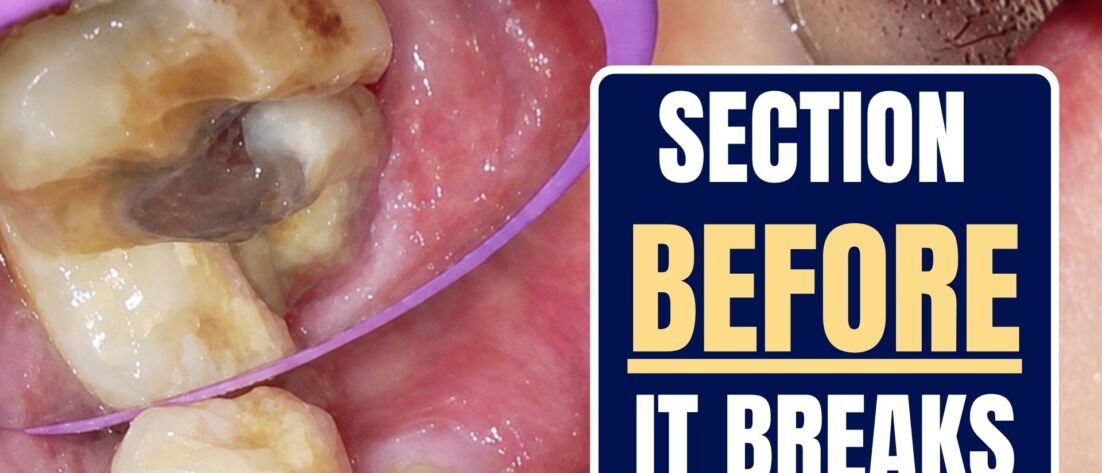
The crown I could grip is gone, and suddenly I have a much trickier extraction on my hands.
Sound familiar? Could I have sectioned it BEFORE it broke? Sometimes dividing a tooth early is exactly what makes the extraction more controlled.
When I finally got comfortable with sectioning, it made extractions SO much easier, more predictable and less stressful.
What Sectioning Changes
Extractions are simple if you think about it…you either make the hole bigger (expansion of socket or bone removal) or the tooth smaller. That is it.
Sectioning is not just about making a big tooth smaller. It changes the mechanics.

Take a mandibular molar with divergent roots: why ask both roots to come out along the same path when their anatomy is telling you otherwise? Divide the tooth, and each root can follow its own path of least resistance.
Ask yourself: what is stopping each root from coming out? That is often a more useful question than “How do I pull harder?”

Once separated, the roots can be assessed and elevated individually. You may need less force and less leverage against the surrounding bone. That is the real benefit.
When to Consider It Early
Nowadays I section 70-80% of multirooted (not fused) molars right from the start.
Before you reach for the forceps, look at the radiograph and the crown. These are the cases that should make you think about sectioning sooner:
• Divergent roots that resist a common path of withdrawal
• Curved or bulbous roots that may resist intact delivery
• Extensive caries, large restorations or limited coronal structure that may fracture under force
• Root-filled teeth with compromised remaining structure
• Dense or less expansile bone, especially when ridge preservation matters
Does every molar with two roots need sectioning? Of course not.
These clues just tell you when an intact extraction could become a fight. However, my current threshold for sectioning is pretty low!

Pay particular attention to the heavily restored or root-filled molar. The forceps might be gripping a restoration or a thin wall, rather than a sound tooth. If that gives way, you lose the purchase you were relying on and may be left chasing deeper roots.
Read the Movement, Not Just the Radiograph
The radiograph is only part of the story. What is the tooth telling you once you start? Perhaps you get a little movement with controlled luxation, then nothing more. Or perhaps the crown starts to crumble while the roots barely move. That is your cue to pause.
Is a curved or divergent root engaging bone? Are you trying to move two roots in directions they simply cannot go together? If the problem is the path of withdrawal, another forceps attempt will not change the anatomy. Sectioning might.
We have all been tempted by “just a little more.” And sometimes that works! But if each attempt adds force without adding useful movement, take the hint. Reassess the mechanics before your crown or the surrounding bone pays for it.
For a deeper discussion of when to change course, listen to our episode on sectioning and elevating teeth during difficult extractions.
For 4K extraction videos of sectioning and elevating in real world cases, check out Sectioning School on Protrusive Guidance (under Jaz’s masterclasses).

Here’s an example video Jaz published on sectioning an upper molar – in his online extractions course (sectioning school) he goes much deeper:
Planned Sectioning Vs Rescue Sectioning
With planned or early sectioning, you may still have:
• Good visibility
• Useful coronal tooth structure
• Recognisable anatomy
• Better control of bur positioning
• A deliberate plan for each root
With rescue sectioning, you may now be dealing with:
• A fractured crown
• Reduced purchase
• Deeper remaining root fragments
• More difficult visualisation
• Less favourable access
Of course, even well-planned extractions can surprise you. The point is to spot the moment when keeping the tooth intact is costing you more control than it is giving you.
Is using a bur automatically less conservative? Not necessarily. If the roots are the obstacle, dividing the tooth may spare you repeated force, excessive socket expansion or extra bone removal. Sometimes bone removal is still needed for access or a safe path out. The question is which approach is kinder to the surrounding tissues in this case.
Picture the same molar extracted two ways. One dentist keeps pushing until the crown breaks; another sections early and removes each root with control. Which was really more conservative? The label “simple extraction” tells you very little, especially if you are trying to preserve the ridge for future restoration.
Have a Plan Before Picking Up the Forceps
Before starting, check the crown, restorations, roots, bone, access and nearby anatomy. Then ask one slightly uncomfortable question: if this crown fractures, what am I going to be left with?
Plan A may be controlled luxation and intact delivery. Plan B might be sectioning. Plan C may involve improving access or removing limited bone where indicated. And if the risk goes beyond your skills or resources, stop and refer. It is much easier to make that call before the crown has snapped.

Having a Plan B is not admitting defeat. It means you have the equipment, visibility and confidence to change course at the right time. Know your limits too; a referral is a good decision when the case calls for it.
We also discuss planning for extraction complications, including deciding when to section roots or raise a flap. That episode explicitly raises this planning question.
When Should You Stop and Section?
There is no magic number of luxation attempts. If movement has plateaued, your purchase is getting worse, or intact delivery looks likely to demand excessive force or bone expansion, stop and reconsider. You still have a choice while the crown and access are intact.
A great lesson I have shared many times on the podcast that I learned via osmosis is the 6 second rule. If nothing is really happening in 6 seconds, reassess and change angle/position/instrument/section i.e. change it up!
Nobody awards extra points for presenting an intact molar at the end! The goal is safe, predictable removal with as little unnecessary trauma as possible. If the tooth stops progressing, ask: does it need more force, or a different strategy? Sometimes the best time to section is before things get difficult.
Continuing Education Information
This activity may be eligible for continuing education credit through Protrusive Guidance. Participants must complete the associated quiz inside Protrusive Guidance to obtain a CPD/CE certificate.
Cost:
Access to this CE activity is included with an active Protrusive Guidance membership. Current membership pricing is available at www.protrusive.app.
Cancellation & Refund Policy:
Memberships may be cancelled at any time. Access to CE activities remains active until the end of the current billing cycle. Subscription charges are non-refundable once processed. Full details are available at www.protrusive.app.
Delivery: Self-instruction (online) · Location: Online
Contact: manager@protrusive.co.uk