Podcast: Play in new window | Download (Duration: 46:20 — 64.6MB)
Subscribe: RSS
Just qualified — so why does it feel like the learning is only just beginning?
What should you actually focus on in year one: the flawless dentistry on your feed, or something far less glamorous?
How do you tell a patient their nerve might die — without it sounding like YOUR fault?
And when a patient says “just do whatever you think” — what do you say back?
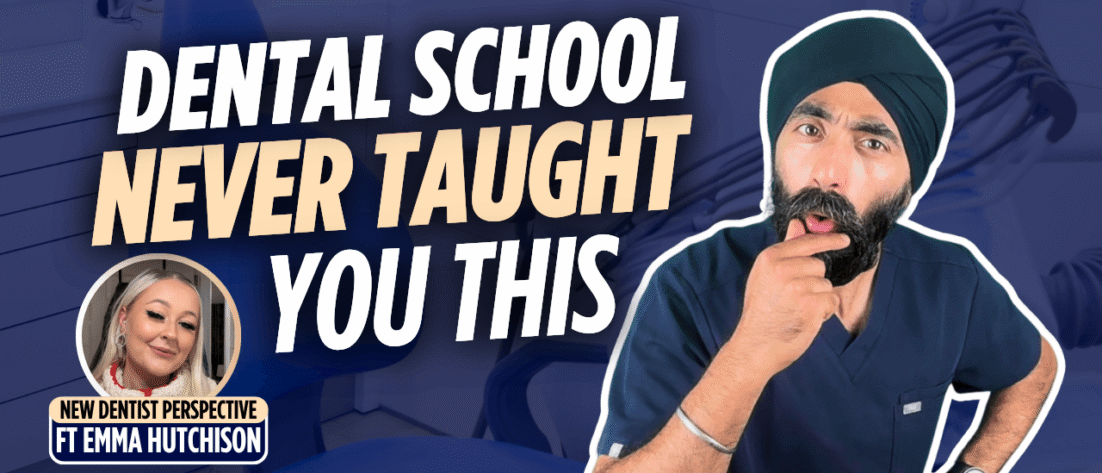
This is the conversation every new dentist needs and every experienced one recognises. Our guest is Dr Emma Hutchison — a former dental nurse who trained at the University of Glasgow, and has been the face of the Protrusive Students series across her studies. We recorded in her final weeks of dental school, right on the threshold of practice, and talked through everything the syllabus skips: the safe-beginner mindset, what to learn (and what to ignore) early on, how to protect your standards under time pressure, which cases to take on, and how to talk to patients about risk, cost and consent so the words actually land. If you’re fresh out, this one hits hard. If you’re an oldie, it’s a trip down memory lane — and a reminder of how far you’ve come.
Protrusive Dental Pearl: Predict the Complication Before It Happens
A communication pearl for every deep restoration. When a filling sits close to the nerve — a big cavity, a crack — name the likely complication before it happens. Show the patient the images, then tell them what to expect: a twinge to cold or hot that can linger a few days, so keep taking painkillers and keep the area clean. And warn them what a red flag looks like: a severe throbbing ache keeping them up at night, or pain out of the blue without eating or drinking, means the nerve is struggling and they should call you.
Do this and, if the complication ever arrives, you look like the expert who called it — not someone something went wrong for. Skip it and reception fields the panicked calls instead. It reassures the patient, lowers your callback rate, and quietly reduces your risk profile. Obvious, easy to forget, and worth saying out loud every single time.
What You’ll Take From This Episode
- The safe-beginner mindset — why qualifying is the driving licence, not the destination, and how the happiest dentists keep getting 1% better.
- Just-in-time learning — study for the cases actually in your diary, not the obscure pathology you won’t meet for years.
- Get good before you get fast — master the bread and butter, protect a little extra time early, and reflect on every procedure.
- Clever hacks vs cutting corners — how to tell the difference, and why every shortcut quietly rewires the habit.
- Consent that works — getting patients to own the problem, and giving a clear recommendation instead of a fifteen-item menu.
Highlights of This Episode
- 00:00 Teaser
- 01:05 The Things Dental School Doesn’t Prepare You For
- 03:05 Communication Pearl: Predict the Complication Before It Happens
- 05:35 Life as a Final-Year Dental Student on Outreach
- 09:55 Why You’re Only a “Safe Beginner” When You Qualify
- 13:45 Master Bread-and-Butter Dentistry Before the Fancy Stuff
- 16:05 Just-in-Time Learning: Study for the Cases in Front of You
- 18:05 Get Good Before You Get Fast (and Protect Your Time)
- 19:45 Clever Hacks vs Cutting Corners: Don’t Lose Your Standards
- 24:14 Midroll
- 27:46 The Skills to Nail in Your First Year as a Dentist
- 30:11 Which Cases to Take On — and Learning From Mistakes
- 35:46 How to Explain Risk and Get Patients to Own the Problem
- 41:26 When Patients Refuse the Ideal Treatment: Start With Their Goal
- 44:26 Treatment Planning Without the Overwhelm: Loom & “Guess Who”
- 47:36 Claim Your CPD & Become the Next Protrusive Student
- 47:38 Outro
Dr Emma Hutchison came to dentistry the long way round — from a dental nursing background into dental school at the University of Glasgow, with final-year outreach on the Kintyre peninsula in Campbeltown. She has been the face of the Protrusive Students series throughout her studies, and this episode marks her crossing from student to newly qualified dentist. On behalf of the whole Protruserati: we’re proud of you, Emma.
Become the next Protrusive Student: with Emma qualifying, we’re looking for the next keen student who wants part-time work, an income while studying, and to contribute to Protrusive — or a nudge if you know one. DM the team inside the Protrusive Guidance app.
Resources & Mentions From This Episode
- Quick & slick rubber dam — the in-app video series on quadrant isolation, for building the rubber dam habit from day one.
- 21-Day Photography Challenge — the in-app challenge that walks you through capturing every clinical photo, including the dreaded occlusal shots, in your first three weeks.
- Loom School — in-app training on async, Loom-video treatment planning (roughly 90 minutes of CPD across around 15 bite-sized lessons).
Access the above masterclasses and more when you subscribe to the Ultimate or Infinity plan.
Want more?
If you enjoyed this episode, check out: Periodontics for Beginners – PS008
#PDPMainEpisodes #CareerDevelopment #Communication
Listen, Subscribe, Earn CPD
Listen: Subscribe to the Protrusive Dental Podcast on Spotify, Apple Podcasts, or YouTube.
This episode is eligible for 0.5 CE credit via the quiz on Protrusive Guidance.
This episode meets GDC Outcomes A and D.
AGD Subject Code: 770 Self-Improvement
Aim & Learning Outcomes
Aim: To give early-career dentists a practical framework for the transition from dental school to independent practice — how to keep developing, how to protect clinical standards under time pressure, and how to communicate risk and treatment options as part of valid consent.
Learning Outcomes — by the end of this episode, dentists will be able to:
- Apply a “just-in-time” approach to continuing development, prioritising the competencies relevant to the cases in front of them over isolated advanced techniques.
- Differentiate time-saving efficiencies from quality-compromising shortcuts, and describe strategies to maintain clinical standards early in practice.
- Apply structured communication techniques to explain procedural risk, establish a patient’s treatment goal, and make a clear, defensible recommendation as part of valid consent.
Continuing Education Information
This activity may be eligible for continuing education credit through Protrusive Guidance. Participants must complete the associated quiz inside Protrusive Guidance to obtain a CPD/CE certificate.
Cost:
Access to this CE activity is included with an active Protrusive Guidance membership. Current membership pricing is available at www.protrusive.app.
Cancellation & Refund Policy:
Memberships may be cancelled at any time. Access to CE activities remains active until the end of the current billing cycle. Subscription charges are non-refundable once processed. Full details are available at www.protrusive.app.
Delivery: Self-instruction (online) · Location: Online
Contact: manager@protrusive.co.uk