Podcast: Play in new window | Download (Duration: 1:02:24 — 86.6MB)
Subscribe: RSS
Your patient brushes well, avoids sweets — and still keeps getting decay. What if the answer isn’t in their mouth at all?
What if two inexpensive finger-prick tests told you more about a patient’s gum disease and implant prognosis than anything on the radiograph?
And here’s the uncomfortable one: if the science is this clear, is not checking starting to look like a medico-legal risk? Especially for imlpant surgery!
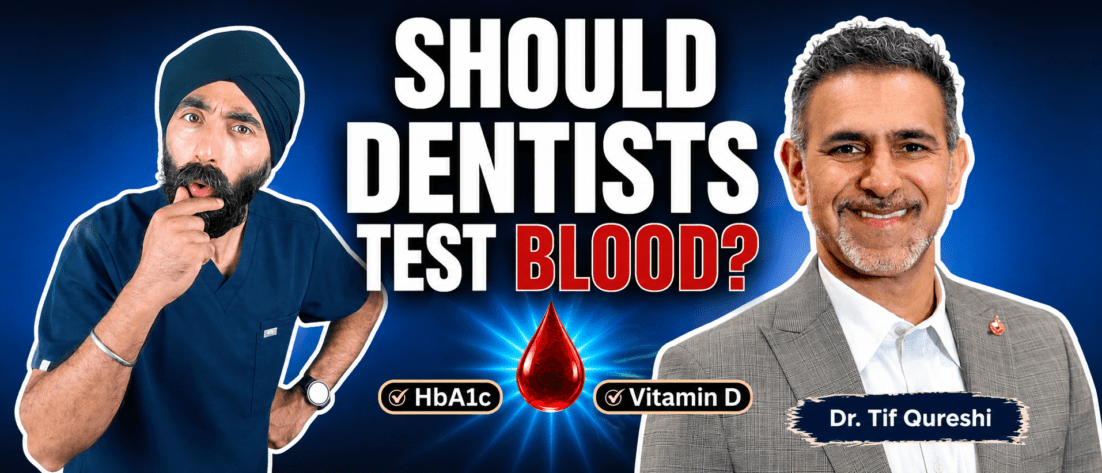
This is a conversation with Dr Tif Qureshi — the dentist who changed how the profession thinks about the lifelong patient, the envelope of function, and Align, Bleach, Bond. He’s gone down a new rabbit hole: metabolic health. In general practice he’s now doing blood tests — HbA1c and vitamin D — and making the case that the mouth isn’t connected to the body, it is the body. This isn’t about becoming a “biological dentist” (as you’ll hear, Tif is refreshingly blunt about the wilder end of that world). It’s about respecting the biology, screening sensibly, and helping patients where we’re genuinely placed to help.
Protrusive Dental Pearl: Test Yourself First
Before you even think about introducing blood tests for your patients, ask whether you’re checking your own biomarkers at a sensible interval. The deepest way to understand this topic is to learn it on yourself and your family first — run your own HbA1c, vitamin D, iron, and liver and kidney markers, and see what the data tells you.
Start quarterly, like hygienist visits, then stretch to six-monthly or annual once things look good. Getting invested in your own numbers is what makes better food and lifestyle choices actually stick — and it’s the honest starting point for ever offering this to a patient.
What You’ll Take From This Episode
- The metabolic lens — why one disordered glucose-and-insulin system sits under so much chronic and dental disease, and why dentistry is well placed to act on it.
- Sugar, redefined — why patients who avoid sweets still get decay, and how frequency of starchy carbs drives the problem.
- The two biomarkers that matter most — what HbA1c and vitamin D each tell you about caries, perio and healing.
- How to run it in practice — finger-prick logistics, what to test, and how to raise it on the medical history form.
- The medico-legal case — why documenting these markers can protect you before implant, graft and perio work.
Highlights of This Episode
- 00:00 Why Dentists Should Care About Blood Tests
- 06:00 Metabolic Disease: The Root Cause Dentists Miss
- 13:00 Why Starchy Carbs Cause Decay, Not Just Sugar
- 15:50 HbA1c and Caries: What the SHIP Study Shows
- 21:00 Insulin Resistance: The Hidden Driver of Gum Disease
- 26:00 How to Talk to Patients About Diet Without Scaring Them
- 31:00 Why Vitamin D Deserves a Place in Dentistry
- 34:00 Vitamin D, Implant Failure and Perio Risk
- 37:00 Blood Tests as Medico-Legal Defence
- 42:00 What Dentists Should Test: HbA1c and Vitamin D
- 44:00 How In-Practice Blood Testing Actually Works
- 50:00 The Mouth Is the Body: Screening, Not Diagnosing
- 51:00 Is This Biological Dentistry? An Honest Answer
- 57:00 How to Learn Blood Testing for Your Practice
From the Guest
Dr Tif Qureshi qualified from King’s College London in 1992 and is a Past President of the British Academy of Cosmetic Dentistry. He is Founder and Clinical Director of IAS Academy, best known for pioneering Align, Bleach, Bond and Progressive Smile Design, and as a teacher of the Dahl concept. His current focus is metabolic health in general practice.
👉 IAS Academy — Align, Bleach, Bond, the Dahl concept, and blood-testing / metabolic health training
Coming soon: Join Dr. Tif in one-day metabolic health programme. He has spent years connecting the dots between what’s happening in the mouth and what’s happening in the body. The results are undeniable: better outcomes, stronger case acceptance, and a rock-solid medico-legal position.
This one-day course will change the way you practise. For good.👉Metabolic Health in Dentistry
References & Further Reading
Studies and sources referenced in this episode:
- Song I-S, et al. Severe Periodontitis Is Associated with Insulin Resistance in Non-abdominal Obese Adults. J Clin Endocrinol Metab, 2016;101(11):4251–4259. Insulin resistance as an independent risk factor for severe perio in normal-weight adults.
- Botelho J, et al. Vitamin D Deficiency and Oral Health: A Comprehensive Review. Nutrients, 2020;12(5):1471. Vitamin D across caries, periodontitis, orthodontic and surgical outcomes.
- Schmolinsky J, Kocher T, Rathmann W, Völzke H, Pink C, Holtfreter B. Diabetes status affects long-term changes in coronal caries – The SHIP Study. Sci Rep. 2019 Oct 30;9(1):15685. doi: 10.1038/s41598-019-51086-z. PMID: 31666549; PMCID: PMC6821733.
Want more?
If you enjoyed this episode, check out: Why do some Dentists find Dahl Distasteful? – PDP016.
#PDPMainEpisodes #BeyondDentistry #Communication
Listen, Subscribe, Earn CPD
Listen: Subscribe to the Protrusive Dental Podcast on Spotify, Apple Podcasts, or YouTube.
This episode is eligible for 1.0 CE credit via the quiz on Protrusive Guidance.
This episode meets GDC Outcomes C and A.
AGD Subject Code: 730 Oral Medicine, Oral Diagnosis, Oral Pathology
Aim & Learning Outcomes
Aim: To help dental practitioners understand the link between metabolic health and oral disease, and to evaluate whether simple in-practice biomarker screening has a place in their care of patients.
Learning Outcomes — by the end of this episode, dentists will be able to:
- Describe how disordered glucose and insulin metabolism relates to caries, periodontal disease and healing outcomes, and explain what HbA1c and vitamin D each indicate.
- Apply a structured, non-alarmist approach to discussing diet and biomarker screening with patients, within the professional boundary of screening rather than diagnosing or prescribing.
- Evaluate the clinical and medico-legal case for documenting relevant biomarkers before periodontal and surgical treatment, and identify when to refer to a medical colleague.
Continuing Education Information
This activity may be eligible for continuing education credit through Protrusive Guidance. Participants must complete the associated quiz inside Protrusive Guidance to obtain a CPD/CE certificate.
Cost:
Access to this CE activity is included with an active Protrusive Guidance membership. Current membership pricing is available at www.protrusive.app.
Cancellation & Refund Policy:
Memberships may be cancelled at any time. Access to CE activities remains active until the end of the current billing cycle. Subscription charges are non-refundable once processed. Full details are available at www.protrusive.app.
Delivery: Self-instruction (online) · Location: Online
Contact: manager@protrusive.co.uk