Podcast: Play in new window | Download (Duration: 46:31 — 64.8MB)
Subscribe: RSS
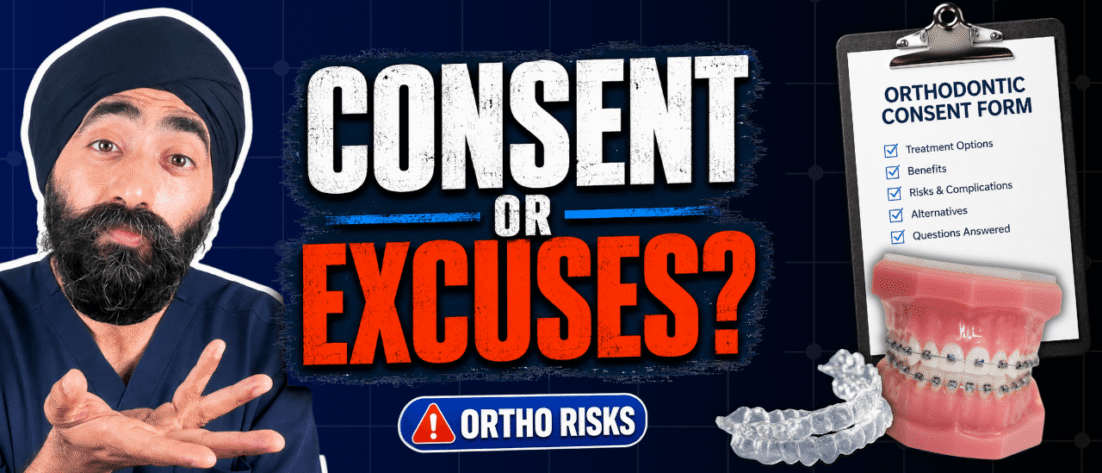
How good is your consent for orthodontics — really?
More adults are having ortho, and more GDPs are providing it. So which risks should you be discussing with every single patient — and which ones depend on the person in the chair?
When a case is heading for a big overjet or a tricky rotation, is that a conversation you have at the start, or one you scramble to explain halfway through?
And what actually makes a consent form legally valid — the signature, or everything around it?
This episode brings together two perspectives you don’t often hear in the same room. Dr Zaid Esmail is a specialist orthodontist and founder of the Online Orthodontic Academy, who mentors GDPs through fixed and aligner cases. Dr Neel Jaiswal returns for the dento-legal view — he’s a dentist and the founder of Professional Dental Indemnity (PDI). Together with Jaz, they get very specific about what individualised consent looks like in practice, and how to build a process your patients remember and a court respects.
Protrusive Dental Pearl: Make Your Patient Feel Unique
It might be your 100th, 500th or 1,000th case — but for the patient in the chair, this is a significant event. Never forget that. A routine extraction is routine for you; for them it’s a big deal, and remembering that makes you a better communicator.
To make a specific risk stick, make the patient feel unique. Point to their OPG: “Your sinus here is actually really interesting,” or “Did you know your roots are unusually long?” Patients remember a risk framed as if they’re a special case far better than a generic warning. Make it personal, and the consent becomes memorable.
What You’ll Take From This Episode
The whole episode turns on one idea: generic, templated consent is no longer defensible — the skill is individualising the form to the patient in front of you. Premium members get the full breakdown; here’s the shape:
- The layers of valid consent — consent is like an onion; a signed form and a documented conversation each cover a gap the other leaves open.
- Individualising risk from the records — how the OPG and photos turn a generic warning (resorption, devitalisation, recession, relapse) into a patient-specific one.
- The two-appointment consent flow — records, individualised risks, thinking time, and why you sign or initial every line.
- The Class II Div 2 overjet trap — the case that looks like simple crowding and ends in a big overjet, and how to consent for it before you start.
- When to treat, add an option, or refer — the GDC line on offering all options, and building alternatives into the form.
Highlights of This Episode:
- 00:00 Teaser
- 01:01 Consent in Orthodontics: Why It Has to Be Individualised
- 02:59 Protrusive Dental Pearl: Make Your Patient Feel Unique
- 07:58 What Makes Orthodontic Consent Different
- 10:08 How Much Ortho Litigation Comes From Consent?
- 11:53 What Makes Consent Valid and Patient-Specific
- 12:26 Individualising Ortho Risk from the OPG
- 13:11 Using the ClinCheck as a Consent Tool
- 14:40 How to Structure the Consent Appointment
- 15:30 Root Resorption, Devitalisation, Recession and Relapse
- 19:37 Should You Initial Every Line of a Consent Form?
- 21:50 Midroll
- 27:11 Building a Multi-Layered Consent Process
- 29:31 Consenting for Fees, Relapse and Retainers
- 34:41 The Class II Div 2 Overjet Trap
- 37:51 When Should a GDP Refer an Ortho Case?
- 40:31 How to Learn Orthodontics with Mentorship
- 47:01 Outro
Dr Zaid Esmail is a specialist orthodontist. He founded the Online Orthodontic Academy to teach GDPs orthodontics — assessment, diagnosis and treatment planning across fixed appliances and aligners — with one-to-one case mentorship. He’s extended a 10% discount to the community with the code PROTRUSIVE.
👉 Online Orthodontic Academy — online ortho mentorship, fixed & aligners, Level 7 Diploma
Dr Neel Jaiswal returned for the dento-legal perspective. He’s a dentist and the founder of Professional Dental Indemnity (PDI), which introduces dentists to insurance-based indemnity cover.
Request a Quote for Insurance and Get £100 off
👉 Professional Dental Indemnity (PDI) — insurance-based dental indemnity
Want more?
If you enjoyed this episode, check out: Consent Is Like An Onion – Are You Consenting Your Patients Correctly? – PDP113
Tags
#PDPMainEpisodes #OrthoRestorative #Communication
Listen, Subscribe, Earn CPD
Listen: Subscribe to the Protrusive Dental Podcast on Spotify, Apple Podcasts, or YouTube.
This episode is eligible for 0.5 CE credit via the quiz on Protrusive Guidance.
This episode meets GDC Outcomes A
AGD Subject Code: 565 Documentation & Risk Management
Aim & Learning Outcomes
Aim: To help dental practitioners obtain valid, individualised consent for orthodontic treatment — identifying the risks that apply to every patient, tailoring them to the individual, and structuring a consent process that is both comprehensible to the patient and defensible in law.
Learning Outcomes — by the end of this episode, dentists will be able to:
- Describe the elements that make orthodontic consent valid and patient-specific, including the material-risk standard and the role of reasonable alternative treatments.
- Apply a structured, multi-layered consent process — individualising risk from the clinical records and documenting the discussion — to an individual orthodontic patient.
- Identify the case types and clinical situations that warrant additional consent, an alternative option, or onward referral to a specialist.
Continuing Education Information
This activity may be eligible for continuing education credit through Protrusive Guidance. Participants must complete the associated quiz inside Protrusive Guidance to obtain a CPD/CE certificate.
Cost:
Access to this CE activity is included with an active Protrusive Guidance membership. Current membership pricing is available at www.protrusive.app.
Cancellation & Refund Policy:
Memberships may be cancelled at any time. Access to CE activities remains active until the end of the current billing cycle. Subscription charges are non-refundable once processed. Full details are available at www.protrusive.app.
Delivery: Self-instruction (online) · Location: Online
Contact: manager@protrusive.co.uk