Podcast: Play in new window | Download (Duration: 44:01 — 61.4MB)
Subscribe: RSS
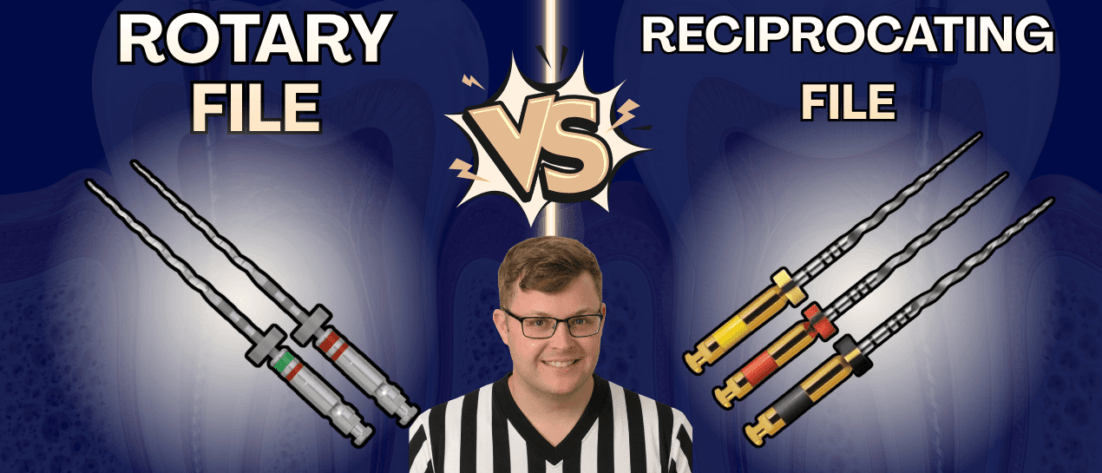
Rotary or reciprocating files — which should you actually be using?
Is one safer than the other? Does reciprocation really reduce file separation? Are you choosing your system because it suits the canal anatomy, or because it is simply the one you were taught?
Endodontic file systems can feel like a maze of brands, tapers, alloys, motions and marketing claims. But beneath all that noise, the real question is much more practical: what is your file doing inside the canal, and what compromise are you accepting?
In this episode, Dr Samuel Johnson returns to unpack the Endo Showdown: rotary versus reciprocating files. We cover file motion, glide paths, shaping philosophy, NiTi metallurgy, cyclic fatigue, torsional fatigue, and why no system is perfect.
Protrusive Dental Pearl
A palliative root canal can be useful for an unrestorable tooth if disinfecting the canal allows infection to heal and natural bone to recover before extraction and future implant planning.
⚠️ Do not dismiss root canal treatment purely because the tooth is not a long-term functional restoration.
✅ Where appropriate, consider whether endodontic disinfection could improve the future implant site by allowing natural bone healing.
Key Takeaways
- The purpose of shaping is not simply to scrape canal walls; it is to create space for irrigant flow.
- Irrigation is the most important part of root canal disinfection.
- Rotary files move in a continuous 360-degree rotation.
- Reciprocating files cut in one direction and reverse before excessive stress builds up.
- Modern reciprocation is designed to cut, release and gradually progress apically.
- File choice is not just about motion; metallurgy, taper, design and operator experience all matter.
- NiTi hand files with strong shape memory may be problematic in curved canals because they want to straighten.
- Martensitic heat-treated files are more flexible and can better follow canal curvature.
- Unwinding flutes are a warning sign that a file may be close to separation.
- Inspect files regularly during treatment, especially in curved, calcified or difficult canals.
- A glide path is essential before introducing larger rotary or reciprocating files.
- Without a glide path, a shaping file may create its own path, risking ledging, transportation or perforation.
- “Grabby” files pull themselves into the canal; this can be useful in experienced hands but risky if forced.
- Reciprocating systems can feel simpler and safer, but they are not foolproof.
- Cyclic fatigue happens when a file repeatedly bends around a curve until microcracks form.
- Torsional fatigue happens when part of the file binds while the motor continues to turn.
Highlights of the episode:
- 00:00 Teaser
- 00:47 Introduction
- 02:13 Protrusive Dental Pearl: Palliative Root Canal Treatment
- 05:30 Main Question: Rotary vs Reciprocating Files
- 06:31 Hybrid File Motions
- 08:19 File Choice Is More Than Motion
- 10:26 Purpose of Shaping in Endodontics
- 11:10 Chemo-Mechanical Preparation
- 11:34 Rotary Motion in Root Canal Treatment
- 11:45 Origins of Reciprocation
- 12:21 Balanced Force Technique
- 18:00 NiTi K-Files vs Stainless Steel K-Files
- 22:37 Practical Advice: Inspect the File
- 23:40 Rotary Can Also Be a One File System
- 24:24 Reciprocation and Sense of Safety
- 24:47 “Grabby” Files
- 24:53 Midroll
- 33:54 Choosing Between Rotary and Reciprocating
- 35:20 Cyclic Fatigue
- 37:41 Endo Radar Pro Ads
- 40:20 Torque and RPM in Endodontics
- 41:41 Why Reciprocation Advances
- 42:56 Debris Extrusion in RCT
- 43:34 Benefits of Rotary Systems
- 44:13 Tactile Feedback in Root Canal Treatment
- 45:21 Outro
Want more?
Check out previous episode with Dr. Samuel Johnson: Working Lengths and Troubleshooting Apex Locators – PDP216
🦷 Looking for an endomotor?
Upgrade your endodontic workflow with the Woodpecker Endo Radar Pro. Head to protrusive.co.uk/endomotor and use coupon code PROTRUSIVE at checkout to claim an exclusive discount and your choice of complimentary file system.
#PDPMainEpisodes #EndoRestorative
This episode is eligible for 0.5 CE credit via the quiz on Protrusive Guidance.
This episode meets GDC Outcomes C
AGD Subject Code: 070 Endodontics
Aim: To improve dentists’ understanding of rotary and reciprocating endodontic file systems, including file motion, glide path creation, file metallurgy, fatigue mechanisms, irrigation principles, and practical steps to reduce procedural risks.
Dentists will be able to –
- Understand the clinical differences between rotary and reciprocating file motions and how these may influence endodontic workflow
- Recognise key risk factors for file separation, including cyclic fatigue, torsional fatigue, file distortion and inappropriate file use
- Apply practical principles around glide path creation, irrigation, file inspection and system selection in endodontic treatment
Continuing Education Information
This activity may be eligible for continuing education credit through Protrusive Guidance. Participants must complete the associated quiz inside Protrusive Guidance to obtain a CPD/CE certificate.
Cost:
Access to this CE activity is included with an active Protrusive Guidance membership. Current membership pricing is available at www.protrusive.app.
Cancellation & Refund Policy:
Memberships may be cancelled at any time. Access to CE activities remains active until the end of the current billing cycle. Subscription charges are non-refundable once processed. Full details are available at www.protrusive.app.
Delivery: Self-instruction (online) · Location: Online
Contact: manager@protrusive.co.uk