Podcast: Play in new window | Download (Duration: 1:02:04 — 86.2MB)
Subscribe: RSS
Are posterior tooth contacts really harmless?
Could group function and non-working side interferences be driving muscular TMD, headaches, and facial pain?
And can digital occlusal data change how we approach bite adjustment?
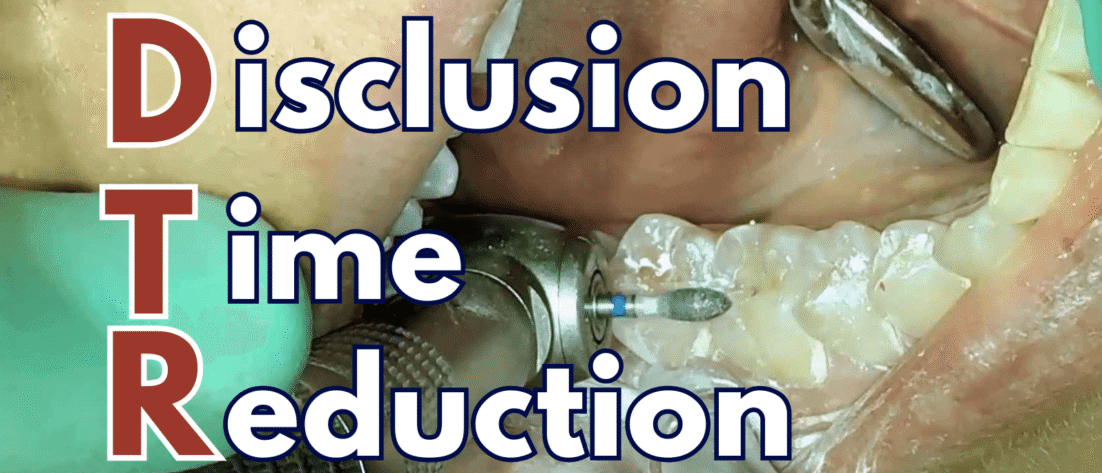
Dr. Jeremy Bliss joins the podcast to tackle one of the most controversial topics in dentistry: Selective Grinding/Equilibration for TMD but specifically Disclusion Time Reduction (DTR). With a strong focus on restorative technology, lasers, and T-Scan analysis, Jeremy brings a practical and experience-driven perspective to occlusion and bite therapy.
This episode breaks DTR down from the very beginning—what it is, how it differs from traditional equilibration, and why reducing posterior tooth contact during excursive movements may help certain susceptible patients. The conversation also explores canine guidance vs group function, macro vs micro occlusion, and where DTR fits within evidence-based dentistry when conservative care has failed.
Protrusive Dental Pearl: Don’t buy advanced occlusal or motion-tracking tech unless your type of dentistry, training, lab support, and local backup can fully use the data—otherwise it’s just a Ferrari stuck in traffic.
Key Takeaways: Disclusion Time Reduction (DTR) & T-Scan
- T-Scan: Provides objective data on tooth contact timing and force—impossible to see with the eye or articulating paper.
- EMG: Tracks temporalis and masseter activity to show how muscles respond to occlusion.
- Goal of DTR: Reduce posterior tooth contact during excursions, shifting contact to canines to relax muscles.
- Patient Selection: Best for symptomatic muscular TMD; requires sufficient canine/incisal overlap.
- Clinical Benefits: Reduces headaches, migraines, muscle tension, parafunctional damage, and progressive tooth wear.
- Procedure: Conservative enamel adjustments (0.5–0.75 mm), guided by T-Scan; posterior teeth should disclude in <0.5 sec.
- Implant Care: Prevent early loading to protect bone and restorations.
- Evidence: Supported by systematic review and clinical cases; improves outcomes over traditional occlusal adjustments.
Highlights:
- 00:00 Teaser
- 00:53 Introduction
- 09:51 Pearl: Buying Advanced Technologies
- 11:53 Interview with Dr. Jeremy Bliss
- 18:08 Introduction to Digital Occlusal Analysis
- 22:46 Challenges and Controversies in TMD Treatment
- 26:09 Explaining T-Scan and Its Benefits
- 32:42 Understanding the Anatomy and Physiology of DTR
- 36:25 Techniques and Tools for DTR
- 38:14 Midroll
- 41:35 Techniques and Tools for DTR
- 44:19 The Impact of DTR on Muscle Tension and Pain
- 48:43 Bruxism Cessation After DTR
- 49:50 Importance of EMG in DTR
- 52:05 Case Study: A Life-Changing DTR Treatment
- 56:59 Conclusion and Future Directions
- 01:00:46 Outro
Systematic Review
Individual Practice Contact: blissdental.co.uk – contact directly via the website form for information about DTR or patient referrals.
DTR Treatment for TMD with Dr Jaz Gulati in Richmond, London
#PDPMainEpisodes #OcclusionTMDandSplints #CareerDevelopment
To learn more about Disclusion Time Reduction, check out: Occlusograms are Lying To Us! Don’t Trust the ‘Heat Map’ – PDP247
This episode is eligible for 1 CE credit via the quiz on Protrusive Guidance.
This episode meets GDC Outcomes C
AGD Subject Code: 180 OCCLUSION
Aim: To understand the principles and clinical applications of digital occlusal analysis and Disclusion Time Reduction (DTR) for managing occlusion-related muscular pain, TMD, and improving restorative dentistry outcomes.
Dentists will be able to:
- Explain the concept of disclusion time and its impact on masticatory muscles.
- Describe how T-Scan and EMG are used to assess occlusal force, timing, and muscle activity.
- Identify appropriate patients for DTR and apply objective data to guide safe occlusal adjustments.
Cost:
Access to this CE activity is included with an active Protrusive Guidance membership. Current membership pricing is available at www.protrusive.app.
Cancellation & Refund Policy:
Memberships may be cancelled at any time. Access to CE activities remains active until the end of the current billing cycle. Subscription charges are non-refundable once processed. Full details are available at www.protrusive.app.
Continuing Education Information
This activity may be eligible for continuing education credit through Protrusive Guidance. Participants must complete the associated quiz inside Protrusive Guidance to obtain a CPD/CE certificate.
Cost:
Access to this CE activity is included with an active Protrusive Guidance membership. Current membership pricing is available at www.protrusive.app.
Cancellation & Refund Policy:
Memberships may be cancelled at any time. Access to CE activities remains active until the end of the current billing cycle. Subscription charges are non-refundable once processed. Full details are available at www.protrusive.app.
Delivery: Self-instruction (online) · Location: Online
Contact: manager@protrusive.co.uk